SQL Server Data Tools in Visual Studio 2012–Customizing the Table Designer Layout

With this post I want to show you a few of the nice shortcuts provided to you in Visual Studio SSDT for quickly customizing the layout of your designers. A few of the items only apply to the table designer, but many apply to other windows within Visual Studio, no matter what project type is being hosted.

image

Number 1 points to the pane swap button. Clicking it will simply swap the positions of the grid and T-SQL windows, like so:

image

The double bar pointed to by number 2 is the resizing handle. Click and drag to adjust the amount of space used by either pane.

image

Note the change of the cursor shape when it’s hovered over the double bars.

There are three buttons pointed to by number 3. The middle one is the default, and indicates you want to split the panes horizontally. If you click the left most of these 3, it will split the panes vertically.

image

Vertical mode is really nice when you have a super wide screen monitor. As you can see, the three buttons have now shifted to the bottom center of the screen, next to the mouse in the above image.

What if you are working on a really small screen, and don’t even have enough real estate to work comfortably with any size split? Well that’s where the right (or bottom if vertically split) button comes in. Click it to shift to tabbed mode. (Note, I suggest you shift back to the default horizontal split first, otherwise the tabs will be on the right instead of the bottom and not quite as easy to use).

image

The last button, number 4, is for the T-SQL pane. It’s also found in almost all code editor windows in Visual Studio. Using it you can split the code view so you can see two different sections of you code at the same time.

image

Great for working with especially large code bases. And this split should exist in any text editor, not just the designer. Whether it’s straight T-SQL, VB.Net, C++, F#, or C# it should work for you.

For a typical desktop user, you’ll probably set these once and forget. But for folks like me who travel a lot, these are a real blessing. When I’m at home, with my laptop hooked up to my 25inch wide screen monitor, I can quickly shift to split screen vertical mode to take advantage of all that width.

When I’m on the road though, working on my laptops small screen (12 inches), I can shift back to horizontal mode, or more often (for me) tabbed mode, for doing my work.

Experiment with different layouts, and find out what works best for you!

SQL Server Data Tools in Visual Studio 2012–Safe Refactoring

With Visual Studio Database Projects (VSDB), you entered into Safe Refactoring mode through the Schema View window. But in SSDT, the Schema View window no longer exists. So how the heck do you do it??

Well first off, let’s define safe refactoring for those who may not have been familiar with the feature in VSDB. It allowed you to right click on a column name, and pick rename. You could then enter a new name, and hit the preview button. Visual Studio would comb through your source code and find every occurrence of that column name for that table and show it to you. If you clicked OK, Visual Studio would then go through and make the change everywhere for you, ensuring you didn’t miss anything.

Before we can do a safe refactor, we need to have something to refactor, and to test with. For this demo, we’ll create a simple view to read the dbo.ArcaneCode table we created in the previous post. Since there is no folder in the dbo schema for views, we’ll first have to create it.

Still working with our AdvWorks sample, open the dbo folder. Right click on it, and pick Add, Folder. Name the folder Views. Let me interject that strictly speaking, this isn’t a requirement. We could have placed the new view source file we’re about to create anywhere. But keeping a file/folder structure consistent with this and other SSDT projects will make maintenance far easier.

OK, once the folder is there, right click on it, again pick add, only this time pick a new View. Name the view dbo.vwArcaneCode.

CREATE VIEW [dbo].[vwArcaneCode] AS 
SELECT [BlogUrl], [BlogAuthor]
FROM dbo.ArcaneCode

And save it. Now return to the table designer for the new ArcaneCode table.

Let’s decide we don’t like the name BlogUrl, and we’d rather call it BlogSite. Well, first we could try putting our cursor into the T-SQL area, and just typing over BlogUrl with BlogSite. What happens?

SNAGHTMLbdd349

Well, as you can see above, the designer on the upper half changes, but the column name in Create Index did not update. Not nearly what we wanted.

Let’s start over. Restore the name in the T-SQL area back to BlogUrl. Now go into the grid at the top, and change it there.

SNAGHTMLc00ed2

Hey, that’s better! Once we tabbed out of the Name column (or clicked elsewhere) it changed the name in all the locations in the T-SQL area. Just what we wanted!

Or is it?

Remember, we also used this column in the vwArcaneCode. Go take a look at its code.

image

As you can see, it remained unchanged. Even worse, there’s now a big red squiggly under the BlogUrl name, indicating we have now created an error in our project. Sigh. OK, one more time.

Go back to the table designer, and reset the name back to BlogUrl. Now we’re finally ready to do this the right way.

Put your cursor somewhere in the column name in the T-SQL area, then right click on the column name. Note, this will not work if you try it in the grid area at the top!

From the menu, pick Refactor, Rename.

image

You’ll now see a dialog appear, giving you a place to enter a new name. Change the name to BlogSite, and make sure the Preview Changes is checked on, then click OK.

SNAGHTMLc89a4f

Once you do, a new window will appear. It will show you everywhere the change would be made.

SNAGHTMLca7716

Looking at the window,  the upper part shows you all the files and the line of code in the file for which a change would be made. If you click on a line, the new version of the code will appear in the lower window. Ahh, there’s the view, and you can see it is being shown with the new change that will be made.

Note that no change has occurred as of yet. You must click the Apply button for anything to actually change. You can also click Cancel to abandon the change.

If you need to know everywhere a column name is used, but don’t want to change it, there’s an easy way to do that too. When we right clicked on the column name and picked Refactor, well a few menu options down was another option called “Find All References”. Picking that will populate a window in your Visual Studio environment.

image

When you click on a line in the above window, your central display in Visual Studio changes to now show the file you clicked on in this window.

There you go, you can now not only safely refactor column names in Visual Studio 2012 SSDT, but you can also find all references to that column within your project.

SQL Server Data Tools in Visual Studio 2012–Table Designer–Other Objects

image

Above is the screen shot of where things were left at the end of the previous post. We had just added a new table and used the designer to create four columns, along with their data types. We also saw how we can edit the table in T-SQL and see updates in the designer’s grid above.

But what’s all that stuff to the right of the grid? It would seem to list the various objects that would be associated with a table. In this case there’s only one, the unnamed Primary Key. But through this are we can also add new objects.

Let’s add a simple index. Right click on the Indexes (0) area. from the menu pick Add New, then for this example we’ll pick a standard Index.

image


When you do, a new index name appears below the Indexes (0) area, with a default name.

SNAGHTMLa8b905

Since this is going to be for the BlogUrl, I’m going to change the name to IX_ArcaneCode_BlogUrl. You’ll see the Indexes collection area has updated to reflect the new name, and the number in parenthesis has been updated to (1), to reflect the number of Indexes.

In the T-SQL area at the bottom, you’ll see some new T-SQL setup and ready for you to update. Here, all you have to do is change the [Column] to be the actual field name you wish to use in the index. In this case, [BlogUrl].

SNAGHTMLaa70bf

Think of the new designer as a combination of easy to use UI with a code generator. Creating other objects works just like you’ve seen here. You right click, pick what you want to add, and Visual Studio SSDT inserts the code template read for you to update.

SQL Server Data Tools in Visual Studio 2012–Table Designer

One of most noticeable enhancements to the data tools (over the previous database projects) is the table designer. Using the AdvWorks project we started in previous posts, let’s add a new table. Since the dbo schema has few tables, let’s add it there.

Expand the  dbo schema, right click on the Tables folder, right click and pick Add, Table as you can see in this illustration.

SNAGHTML28a093

Next you’ll be asked to confirm the type of object you wish to add, and what you want to name it. Ensure the “Table” object type is selected (the red arrow points it out below). Then, give your new table a good name. If you use multiple schemas in your database (and you should) then get into the habit of always typing in the schema name before the table name, even if it’s the default schema. This will prevent you from putting tables into the wrong schema, then having to clean up the mess later.

SNAGHTML2ae15a

You are now presented with the spiffy new table designer. Using it is fairly straightforward, but has some nice abilities.

image

You can begin by simply going to the Name area, and typing in new column names. I’m going to start by changing the word Id to ArcaneId. Next, move to the Data Type box and hit the dropdown. You’ll be presented with a dizzying array of data types!

image

For now I’ll leave it as int, since this will be my primary key, but I’ll add other types momentarily. I’ll leave Allow Nulls off, as well as leaving the default empty. Now add a column by moving down to the next row in the grid, perhaps call it BlogUrl, nvarchar(256). Note that when you pick the nvarchar column type, you’ll have to type right inside the Data Type text area to change the length of the column. Finally add a DateUpdated column, Date data type, an set the default to GETDATE().

Note that as you’ve filled in your columns in the designer, the T-SQL in the box underneath is also updating. It’s a two way street, shift down to the T-SQL code on the bottom. Let’s add a fourth column, but put it under the BlogUrl but above the DateUpdated. Let’s name it BlogAuthor, nvarchar(256), NULL (we’ll allow nulls) and no default.

When you get to the end of the line and VS has confirmed this is valid T-SQL code, it will update the designer area on the top to reflect what you’ve done below.

There is one more thing we should do, something that’s quite common especially in data warehousing. We should have the primary key be an Identity type, that is a column whose value auto-increments with each inserted record. We can’t do that via the designer area at the top. While we could move down to the T-SQL area at the bottom and just type it in, there is a way to do it graphically.

In the designer, click on the row with the ArcaneId. Now go to the Properties window (generally over on the right, below the Solution Explorer if you still have the default VS seutp). About 2/3 the way down you’ll see a property called Identity Specification. Using the + button expand it, then change the Is Identity property to true.

image

Now your designer window should look something like:

image

But that’s just the start, for this isn’t just a table designer, but a designer for keys, constraints, indexes, and more! But that will wait for the next post in the series.

SQL Server Data Tools in Visual Studio 2012–Publish Database Profile

One of the new features in SSDT, and what I consider to be my favorite, is the Publish Database Profiles. With database projects you could set a multitude of settings, everything from ANSI NULLS to whether to drop and create the database with each build. The only issue was these settings applied to the entire project; you had to change them each time you wanted to deploy to a different server, or to change the rules (overwrite vs. incremental for example).

New with SSDT are Publish profiles. They allow you to establish a set of rules and save them for reuse. To start with, right click on the project name and pick Publish from the menu.

image

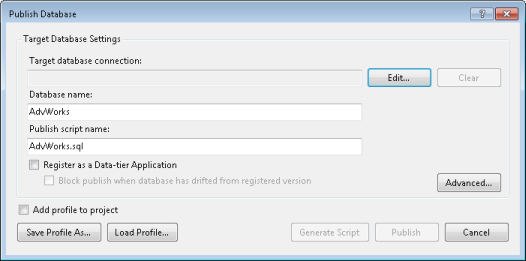
You’ll now see a blank publish page.

SNAGHTML360f9789

Let’s start by tweaking some database settings. Click the Advanced button on the lower right.

SNAGHTML36114075

Here you can get to all of the options you can use to fine tune your database deployment. The most common appear at the top, the less changed ones appear in the list below. In this image I’ve checked on the option to Always re-create the database. This option will wipe out the existing database and recreate it from scratch.

Use this particular option with caution, especially if you are doing it to a database you are sharing with your co-workers (or even worse, production!). When your rebuild the database you’ll also lose any data and have to reload. Sometimes this is a good option, especially in the early stages of development when you’ve made massive changes to the database, or perhaps have gone into the database and made a lot of changes outside the scope of SSDT.

There may be other options you need to change, based on your environment or DBA requirements. Once you’ve changed your options click OK to return to the previous screen.

Back on the Publish Database settings dialog I’ll set the target database connection, and the name I want to use for the database. I can also set the output script name if I wish.


SNAGHTML36153d0b

Next, I want to be able to save this profile so I can reuse it later. Check on the “Add profile to project” option in the lower left, then click the Save Profile As… button.

SNAGHTML36195ad8

I gave it a good name, and made sure to include the most important options such as RecreateDB to indicate a database recreate was one of the options.

As I write this however, there is a bug with SSDT. When you click the “Add Profile to project” button it immediately adds a profile with the original default name. Then when you click the Save button in the dialog above, it adds the profile again, totally ignoring the name you give it. Instead it uses the default name again, only this time with an _1.

I’ve been assured that this bug is already known and has been fixed, and will be released with the next update to SSDT in VS2012. So depending on when you read this, it may or may not be an issue. Regardless, the fix is very easy, just rename the new .publish.xml file to reflect what you wanted it to be.

Once saved come back and hit Publish. The database will now be deployed to the server and the profile will be added to the solution. Here it is, after I’ve renamed the publish profile.

image

Note that I’ve given it a naming convention that specifies the database name, the target server, and any critical options. Here I’ve added “Overwrite” to indicate what will happen when I run it.

To run it, just double click on it. First, Visual Studio will do a build of the SSDT project. If there are any errors the process will be halted and you’ll need to fix them. If not, you’ll be presented with the publish dialog, this time with everything filled out.

SNAGHTML98453db

All you have to do is click Publish and the database will be created/updated using the options you’d picked previously, to the server which you had previously indicated.

Now for the real fun. Repeat the above steps only this time do NOT check the overwrite database option. Now, (after renaming the new profile) you have two publish profiles to pick from.

image

Take this even further. In my current project I have 8 profiles. An incremental and overwrite option for my local computer, the development server, the user acceptance testing server, and the production server. (In my case it’s a one man project, I’m the developer and the DBA all in one.) No longer do I have to juggle the server name, or even worse do a publish but forget to change the server from production back to local.

By far I think this is my favorite feature in SSDT.

SQL Server Data Tools in Visual Studio 2012–Importing a Database

In the previous post we saw how to create a new project using SSDT. In this entry we’ll see how to import an existing database into the project. Start by right clicking on the project (not the solution) and pick Import, Database.

image

The Import Database is similar to the one from the 2010 database projects, but simplified. Use the New Connection button to setup a connection to your database (here I picked Adventure Works 2012). Target Project is disabled, since it’s in the context of the current project.

Import settings can be left at their defaults. The one thing to note is the Folder structure drop down. I personally prefer the default of Schema\Object Type. You can also pick None, which will put all the SQL files in the root of the project. I wouldn’t recommend this option, as it will quickly get difficult to find the files you need to edit. You can also organize by just Schema, or just Object Type. If you are a hard core DBA you might find Object Type more comfortable, since it’s closer to the Object Explorer in SSMS. As I said though, my experience has been Schema\Object Type is the easiest to work with.

SNAGHTML35019c45

When it’s done just click finish, and you’ll see the new structure in the Solution Explorer. Each folder at the top level represents a Schema, or database level object such as Database Triggers.

In the image below, you can see I expanded two of the schemas, HumanResources and Person. Under these are folders for all of the present object types.

image

Note that the HumanResources schema has a folder for Stored Procedures, while Person does not. This is simply because in the database the Person schema has no stored procedures. If you want to add a stored procedure to the Person schema, you’ll want to add a folder to the Person structure and name it Stored Procedures. This isn’t required, you can put the SQL file anywhere you want, but if you mimic the existing organization structure you’ll make it much easier to maintain and expand the SSDT project as you move forward.

Lets expand a branch to see all the files.

image

Finally! We’ve drilled down to the lowest level and can see the individual files that are needed to make up the project.

In the next installment we’ll look at altering some of the database settings. Over the next few weeks we’ll be looking at deployment tools, database snapshots, and how to edit the various file types, and some of the enhancements there, especially around the table editor.

SQL Server Data Tools in Visual Studio 2012

In August I’ll be giving a couple of presentations at devLink. One of them will be on the new SQL Server Data Tools that was released with SQL Server 2012. As you may be aware, I’ve been a proponent of Visual Studio Database Projects since their initial release with Visual Studio 2005.

With SQL Server 2012 the SQL team took ownership of the database projects. They completely retooled them so now they can release them as “out of band” add-ons for Visual Studio. The new version is called SQL Server Data Tools, or SSDT for short. It’s included with VS2012, or you can download a version compatible with Visual Studio 2010 at http://msdn.microsoft.com/en-us/data/tools.aspx.

I’ve been using it for a real world production project for some time now. While I like it, there are some major differences between the new SSDT and the former database projects. Over the next few blog posts I want to highlight some of those differences, culminating with the devLink presentation.

For this series of posts I’ll be using the Visual Studio 2012 Release Candidate, which from here on I’ll simply refer to as VS2012. As this is a Release Candidate there shouldn’t be any noticeable changes between now and the final release.

If you are still on VS 2010 don’t fret, what I’ll describe applies to it as well, assuming you have gone to the link above and downloaded the SSDT add in.

The first difference is with creating a new project. With VS 2012 the older database projects are gone. Only in 2010 can you still do both. Here’s the new project screen shot from VS2010:

SNAGHTML30634815


Here is the screen shot from VS2012.

SNAGHTML3065daa3

As you can see, the Database branch is gone and only the SQL Server Database Project exists.

Now for the next difference. With VSDB Projects, when you created a new project you were immediately walked through a wizard that helped you with various default choices, and allowed you to import a database. With SSDT, once you create a new project you are given a blank slate, an empty project to start from.

image 

If you are creating a new database from scratch, it is left to you to create the entire folder structure, and to name your files correctly.

I’d highly suggest though that you import at least one database, to see how the wizard organizes things, so that you can follow suit. Importing a database is as easy as it was in VSDB Projects, but we’ll save that for the subject of the next blog post.

Simulating SQL Server Work with PowerShell

No, I’m not talking about simulating your job so you can sit home in your PJs and play Call of Duty. (Although if you work out a way to do so, call me!) What I’m speaking of is emulating a workload on your server.

There’s many reasons for wanting to do this. For folks like me, who do a lot of demos, it can be a good way to get your server busy so you can demo things like DMVs or the SQL Provider. Another use would be stress or performance testing your applications. Ensuring you get good retrieval times when the server is loaded.

I have to give a little shout out here to my friend and fellow MVP Allen White (Blog | Twitter). I had attended one of his sessions back at a SQL Saturday, and when I downloaded his samples found a “SimulateWork” PowerShell script among the sample code. In Allen’s script he used the .Net SQLClient library to do his work. I decided to emulate the concept but to rewrite the entire thing using the SQL Provider. I borrowed a few of his queries so I could be sure my results were similar.

The script is pretty simple. I have a function that will load up the SQL Provider, if it’s not already loaded. Next is the SimulateWork function. It has one parameter, how many times you want to execute the code in the loop.

Within the function I load up a series of T-SQL queries against the AdventureWorks2012 database using “here” strings. I then execute them using the Invoke-SqlCmd cmdlet. Finally I have a little code which calls the functions.

My goal with this script was to get the server ram loaded up and simulate some I/O so I could demo a few simple things. Astute observers will notice that, because these are just executing the same T-SQL commands over and over, for the most part SQL Server will just hit its plan cache and memory each time. If those are important to you, I’d suggest altering the T-SQL commands to include a where clause of some sort then each time through the loop add your new where condition to the variable holding the T-SQL.

So without further ado, here’s the full script.

#******************************************************************************
# Simulate Work
#
# This routine will simulate work being done against a SQL Server. Ideal
# for demoing things like the SQL Profiler or DMV Stats. 
#
# The T-SQL queries were tested against the AdventureWorks2012 database. You
# may have to alter some queries if you are on previous versions of
# AdventureWorks.
#
# Author......: Robert C. Cain
# Blog........: http://arcanecode.com
# Twitter.....: http://twitter.com/arcanecode
# Last Revised: July 17, 2012
#
# Credit...: This script is based on one by SQL MVP Allen White.
#   Blog...: http://sqlblog.com/blogs/allen_white/default.aspx
#   Twitter: http://twitter.com/sqlrunr
#
# In his original script, he used the System.Data.SqlClient .Net library to 
# simulate work being done on a SQL Server. I liked the idea, but rewrote 
# using the SQL Provider. A couple of the SQL queries I borrowed from 
# his routine. 
#
# Other uses: The techniques below might also be a good way to stress test
# a system. Alter the t-sql (and probably variable names) and away you go. 
#******************************************************************************

#------------------------------------------------------------------------------
# Loads the SQL Provider into memory so we can use it. If the provider is 
# already loaded, the function does nothing. This makes it safe to call
# multiple times. 
#------------------------------------------------------------------------------
function Load-Provider
{
  # Get folder where SQL Server PS files should be
  $SqlPsRegistryPath = "HKLM:SOFTWARE\Microsoft\PowerShell\1\ShellIds\Microsoft.SqlServer.Management.PowerShell.sqlps"
  $RegValue = Get-ItemProperty $SqlPsRegistryPath
  $SqlPsPath = [System.IO.Path]::GetDirectoryName($RegValue.Path) + "\"
  
  # Check to see if the SQL provider is loaded. If not, load it. 
  [String] $IsLoaded = Get-PSProvider | Select Name | Where { $_ -match "Sql*" }

  if ($IsLoaded.Length -eq 0)
  { 
    # In this case we're only using the SQL Provider, so the code to load the
    # SMO has been commented out. Leaving it though in case you copy and paste it from somewhere
    # and need it. 
    <#
  # ----------------------------------------------------------------------------------------
    # Load the assemblies so we can use the SMO objects if we want. 
    # Note if all you need is the basic SMO functionality like was in 2005, you can get away
    # with loading only the first three assemblies. 
  # ----------------------------------------------------------------------------------------
    $assemblylist = 
    "Microsoft.SqlServer.ConnectionInfo ", 
    "Microsoft.SqlServer.SmoExtended ", 
    "Microsoft.SqlServer.Smo", 
    "Microsoft.SqlServer.Dmf ", 
    "Microsoft.SqlServer.SqlWmiManagement ", 
    "Microsoft.SqlServer.Management.RegisteredServers ", 
    "Microsoft.SqlServer.Management.Sdk.Sfc ", 
    "Microsoft.SqlServer.SqlEnum ", 
    "Microsoft.SqlServer.RegSvrEnum ", 
    "Microsoft.SqlServer.WmiEnum ", 
    "Microsoft.SqlServer.ServiceBrokerEnum ", 
    "Microsoft.SqlServer.ConnectionInfoExtended ", 
    "Microsoft.SqlServer.Management.Collector ", 
    "Microsoft.SqlServer.Management.CollectorEnum"
    foreach ($asm in $assemblylist) {[void][Reflection.Assembly]::LoadWithPartialName($asm)}
    #>

    # Set the global variables required by the SQL Provider    
    Set-Variable -scope Global -name SqlServerMaximumChildItems -Value 0
    Set-Variable -scope Global -name SqlServerConnectionTimeout -Value 30
    Set-Variable -scope Global -name SqlServerIncludeSystemObjects -Value $false
    Set-Variable -scope Global -name SqlServerMaximumTabCompletion -Value 1000

    # Load the actual providers  
    Add-PSSnapin SqlServerCmdletSnapin100
    Add-PSSnapin SqlServerProviderSnapin100
  
    # The Types file lets the SQL Provider recognize SQL specific type data.
    # The Format file tells the SQL Provider how to format output for the 
    # Format-* cmdlets.
    # First, set a path to the folder where the Type and format data should be
    $sqlpTypes = $SqlPsPath + "SQLProvider.Types.ps1xml"
    $sqlpFormat = $sqlpsPath + "SQLProvider.Format.ps1xml"
  
    # Now update the type and format data. 
    # Updating if its already loaded won't do any harm. 
    Update-TypeData -PrependPath $sqlpTypes
    Update-FormatData -prependpath $sqlpFormat
  }
  
  # Normally I wouldn't print out a message, but since this is a demo
  # it will give us a nice 'warm fuzzy' the provider is ready
  Write-Host "SQL Server Libraries are Loaded"

}

#------------------------------------------------------------------------------
# This function simply loads a series of SQL Commands into variables, then
# executes them. The idea is to simulate work being done on the server, so
# we can demo things like SQL Profiler. 
# 
# Parameters: $iterations - The number of times to repeat the loop
#------------------------------------------------------------------------------
function SimulateWork ($iterations) 
{

  $sqlSalesOrder = @"  
  SELECT d.SalesOrderID
       , d.OrderQty
       , h.OrderDate
       , o.Description
       , o.StartDate
       , o.EndDate
    FROM Sales.SalesOrderDetail d
   INNER JOIN Sales.SalesOrderHeader h ON d.SalesOrderID = h.SalesOrderID
   INNER JOIN Sales.SpecialOffer o ON d.SpecialOfferID = o.SpecialOfferID
   WHERE d.SpecialOfferID <> 1
"@

  $sqlSalesTaxRate = @"  
  SELECT TOP 5
         sp.Name
       , st.TaxRate
    FROM Sales.SalesTaxRate st
    JOIN Person.StateProvince sp 
         ON st.StateProvinceID = sp.StateProvinceID
   WHERE sp.CountryRegionCode = 'US'
   ORDER BY st.TaxRate desc ;
"@
  
  $sqlGetEmployeeManagers = @"
  EXECUTE dbo.uspGetEmployeeManagers 1
"@

  $sqlSalesPeople = @"
  SELECT h.SalesOrderID
       , h.OrderDate
       , h.SubTotal
       , p.SalesQuota
    FROM Sales.SalesPerson p
   INNER JOIN Sales.SalesOrderHeader h 
         ON p.BusinessEntityID = h.SalesPersonID ;
"@

  $sqlProductLine = @"
  SELECT Name
       , ProductNumber
       , ListPrice AS Price
    FROM Production.Product
   WHERE ProductLine = 'R'
     AND DaysToManufacture < 4
   ORDER BY Name ASC ;
"@

  $sqlHiringTrend = @"
  WITH HiringTrendCTE(TheYear, TotalHired)
    AS
    (SELECT YEAR(e.HireDate), COUNT(e.BusinessEntityID) 
     FROM HumanResources.Employee AS e
     GROUP BY YEAR(e.HireDate)
     )
   SELECT thisYear.*, prevYear.TotalHired AS HiredPrevYear, 
    (thisYear.TotalHired - prevYear.TotalHired) AS Diff,
    ((thisYear.TotalHired - prevYear.TotalHired) * 100) / 
                 prevYear.TotalHired AS DiffPerc
   FROM HiringTrendCTE AS thisYear 
      LEFT OUTER JOIN 
        HiringTrendCTE AS prevYear
   ON thisYear.TheYear =  prevYear.TheYear + 1;
"@

  
  $mi = $env:COMPUTERNAME + "\SQL2012"  
  Set-Location SQLSERVER:\sql\$mi\databases\AdventureWorks2012

  for ($i=1; $i -lt $iterations; $i++) 
  {
    Write-Host "Loop $i"
    $outSalesOrder = Invoke-Sqlcmd -Query $sqlSalesOrder -ServerInstance $mi -SuppressProviderContextWarning
    $outSalesTaxRate = Invoke-Sqlcmd -Query $sqlSalesTaxRate -ServerInstance $mi -SuppressProviderContextWarning
    $outGetEmployeeManagers = Invoke-Sqlcmd -Query $sqlGetEmployeeManagers -ServerInstance $mi -SuppressProviderContextWarning
    $outSalesPeople = Invoke-Sqlcmd -Query $sqlSalesPeople -ServerInstance $mi -SuppressProviderContextWarning
    $outProductLine = Invoke-Sqlcmd -Query $sqlProductLine -ServerInstance $mi -SuppressProviderContextWarning
    $outHiringTrend = Invoke-Sqlcmd -Query $sqlHiringTrend -ServerInstance $mi -SuppressProviderContextWarning
  }

}

#------------------------------------------------------------------------------
# This is the code that executes the above functions. To change the workload
# simply change the number of iterations. 
#------------------------------------------------------------------------------
Load-Provider

# Number of times to repeat the work simulation. 
$iterations = 100 

Write-Host "Starting simulated work"
SimulateWork $iterations
Write-Host "Done Working"

SQL Server Learning Resources for Beginners

Over the last couple of months I’ve been putting up some of my favorite learning resources. Recently my friend Robin Hunt (twitter | linkedin) at ThinkData Solutions asked me for some recommendations for some SQL Server learning resources for beginners. I thought I’d share that list here as well.

Books

Below are some of my favorite books on the subject. The links are to Kindle format, mostly because I’m a Kindle junkie, but you can also get the paperback version from a link on each page.

Microsoft SQL Server 2008 Step by Step – Any of the step by step books are good quality. There’s no 2012 version of this that I know of, but I’m sure one will be coming.

Microsoft SQL Server 2012 A Beginners Guide – This is a good resource if you are totally new to SQL Server. It’s very complete, covering all aspects of SQL Server Administration.

Introducing Microsoft SQL Server 2012 – This book is an easy read, so even beginners shouldn’t have any issues understanding it. It focuses mostly on new features in 2012, so it’s not quite a comprehensive book. But the Kindle version is FREE, so it makes a good resource for this list.

Professional Microsoft SQL Server 2012 Administration – If you already have some good technical background you might want something one step above a beginner book, but is still easy for people new to SQL Server to understand, then this is a really good book to get. (Disclaimer, I’m a co-author of this book.)

Videos

SQL Share – This is a really unique site. It’s designed for the busy professional. All the videos here are very short, generally in the 10 minute range, and focus on one very specific topic. As I write this, the featured video is on working with foreign keys. It doesn’t have anything in the way of an overall course though, so I’d suggest it as a great resource to learn more about a topic you are interested in, or perhaps read about but don’t quite understand. (Disclaimer,  I have some videos on this site.)


#sqlhelp

Another good resource is Twitter. Yes, Twitter. Do a search on the #sqlhelp hash tag and you’ll see all sorts of great questions being asked and answered. The SQL community does a great job of monitoring this hash tag and providing assistance.

Column Cut Copy Paste in VS SSMS and PowerShell

Did you know it’s possible to do Column based cut, copy and paste in Visual Studio, SQL Server Management Studio, and PowerShell v3? Not many people do. Even less people know that with VS 2010 and SSMS 2012 you get a little “extra” functionality. Watch the video to find out all the juicy details.


SharePoint BI (Business Intelligence) Training Resources

SharePoint is a huge topic unto itself, so I wanted to provide some links that focus on learning how to use SharePoint in the context of Business Intelligence. 

A quick disclaimer, some of the links below are by co-workers or other people I have an affiliation with, financial or otherwise. That’s because I’m lucky enough to work with some of the best people in the field. Also, in the case of the books I’ve linked to the Kindle version where possible, mostly because I’m a Kindle junkie. There are paper versions of the books, and you are free to buy from your favorite retailer.

Books

SharePoint 2010 Business Intelligence 24 hour Trainer – This is a really cool book, in that it’s not just a book. It comes with a DVD loaded with video lessons on how to use the various tools in SharePoint for doing BI. This is the first book to buy if you are new to doing BI in SharePoint.

Business Intelligence in Microsoft SharePoint 2010 – This is a great book which provides an introduction to all of the BI Services available within SharePoint 2010.

Microsoft SharePoint 2010 Business Intelligence Unleashed – Like most of the books in the “Unleashed” series, this takes a much deeper dive into the tools than the previous two books. A good choice once you are ready to move beyond the beginner stage.

Blogs

There aren’t many blogs that focus solely on SharePoint for BI, so I’ve picked out two sites that have a lot of SharePoint for BI content on them.

Data Inspirations -  This blog focuses on all aspects of BI, one of the lead bloggers is Stacia Misner, co-author of the BI in Microsoft SharePoint 2010 book listed above.

BIDN – Many experts in the BI field, myself included, contribute to the Business Intelligence Developer Network. Here you’ll find a wide variety of topics in the BI field, including many on SharePoint BI.

Videos

Pragmatic Works Webinars – On our website we have a big catalog of past webinars (all of which are free to watch), many of which focus on PowerPivot.

Pluralsight – Pluralsight has an extensive catalog of other courses you can pick from. It’s subscription bases so there is a modest fee (starts at $29 US per month last I checked) but well worth it for the training you can get. There’s also a free trial.

For a quick link direct to this post, you can use http://bit.ly/arcanespbi

PowerPivot Training Resources

I’ve been asked to provide links to some useful resources for learning about PowerPivot. Below are a list of my favorite blogs, books, and other sites to learn from.

A quick disclaimer, some of the links below are by co-workers or other people I have an affiliation with, financial or otherwise. That’s because I’m lucky enough to work with some of the best people in the field. Also, in the case of the books I’ve linked to the Kindle version where possible, mostly because I’m a Kindle junkie. There are paper versions of the books, and you are free to buy from your favorite retailer.

Books

Professional Microsoft PowerPivot for Excel and SharePoint – This book covers all aspects of PowerPivot, from using it to installing it to configuration. Everything you want to know in one volume. I wouldn’t particularly call this a beginners book however, it assumes you are competent in BI, Excel, and SharePoint.

Microsoft PowerPivot for Excel 2010: Give Your Data Meaning – This is a good first book to get, it goes deeply into the use of PowerPivot within Excel.

Practical PowerPivot and DAX Formulas for Excel 2010 – Once you are comfortable with PowerPivot, you’ll want to learn more about DAX, Data Analysis eXpressions, the set of functions used to do advanced calculations and aggregations in PowerPivot. I’m a big fan of the way the author, Art Tennick does his books. It’s the Problem – Solution approach, where he demonstrates a common problem then shows one or more ways to solve it. Art also has books on MDX and DMX you should check out.

Blogs

PowerPivot Pro – Probably one of the best blogs around, Rob and Kasper provide excellent content.

Denny Lee’s Blog – Denny works for Microsoft and is part of the PowerPivot team. He provides some really great insights, and is co-author of the Professional Microsoft PowerPivot for Excel and SharePoint book above.

PowerPivot Info – Not so much a blog but a blog aggregator, this site brings the best PowerPivot content on the web to the forefront.

Videos

Pragmatic Works Webinars – On our website we have a big catalog of past webinars (all of which are free to watch), many of which focus on PowerPivot.

Pluralsight – A little shameless self promotion here. I did a complete course on PowerPivot for Pluralsight. This includes both using PowerPivot from Excel and managing PowerPivot within SharePoint. In addition, Pluralsight has an extensive catalog of other courses you can pick from. It’s subscription bases so there is a modest fee (starts at $29 US per month last I checked) but well worth it for the training you can get. There’s also a free trial.

For a quick link direct to this post, you can use http://bit.ly/arcanepivot

SSRS Training Resources

I’ve been asked to provide links to some useful resources for learning about SQL Server Reporting Services. Below are a list of my favorite blogs, books, and other sites to learn from.

A quick disclaimer, some of the links below are by co-workers or other people I have an affiliation with, financial or otherwise. That’s because I’m lucky enough to work with some of the best people in the field. Also, in the case of the books I’ve linked to the Kindle version where possible, mostly because I’m a Kindle junkie. There are paper versions of the books, and you are free to buy from your favorite retailer.

Books

Microsoft SQL Server 2008 Reporting Services Step by Step – A great beginner book, loaded with good examples.

Pro SQL Server 2008 Reporting Services – This book goes much more in-depth with SSRS, delves into many advanced topics.

Microsoft SQL Server Reporting Services Recipes – 2008 or 2012 version of book. This is a great book, especially if you are doing Business Intelligence reporting. Note Amazon says the 2008 version is no longer available in the US, but I’m betting you can find it in your local bookstore or from other retailers. The 2012 version is available for pre-order.

Applied Microsoft SQL Server 2008 Reporting Services – Great book, like the book above covers many aspects of SSRS including BI reporting. Note Amazon only sells the paper version, you can also get it in PDF format direct from the publishers website.

Professional SQL Server 2012 Administration – I mention this book because I wrote the chapter on SQL Server Reporting Services. I don’t go deep into creating reports, although I briefly cover Report Builder. I do go into configuring SSRS and how to do scale out deployments, the total chapter is around 50 pages.

Blogs

Paul Turley – Paul is an active blogger and fellow Microsoft MVP. He is also co-author of the Reporting Services Recipes book I listed above.

Tep Lachev – An active blogger, Teo is not only a good resource for SSRS but for other BI tools such as PowerPivot. He is also author of the Applied Microsoft SQL Server 2008 Reporting Services book, listed above.

Videos

Pragmatic Works Webinars – On our website we have a big catalog of past webinars (all of which are free to watch), many of which focus on SSRS.

Pluralsight – Pluralsight has an extensive catalog of courses, including some great SSRS content. It’s subscription bases so there is a modest fee (starts at $29 US per month last I checked) but well worth it for the training you can get. There’s also a free trial.

For a quick link direct to this post, you can use http://bit.ly/arcanessrs

SSAS Training Resources

I’ve been asked to provide links to some useful resources for learning about SQL Server Analysis Services. Below are a list of my favorite blogs, books, and other sites to learn from.

A quick disclaimer, some of the links below are by co-workers or other people I have an affiliation with, financial or otherwise. That’s because I’m lucky enough to work with some of the best people in the field. Also, in the case of the books I’ve linked to the Kindle version where possible, mostly because I’m a Kindle junkie. There are paper versions of the books, and you are free to buy from your favorite retailer.

Books

Microsoft SQL Server 2008 Analysis Services Step by Step – This is a great beginners book. If you are starting at ground zero, this is the book to start with.

Professional Microsoft SQL Server Analysis Services 2008 with MDX – If you are looking for one book that has everything, this is it. It’s a huge book that covers pretty much everything you need to know about SSAS.

Expert Cube Development with Microsoft SQL Server 2008 Analysis Services – There’s one book that is universally hailed as the “experts’” book, and this is it. Be warned, this is not a beginners book. Don’t try to tackle this until you’ve had at least a little SSAS experience. But it should definitely be on your “must buy” list at some point.

Blogs

Devin Knight – My coworker Devin posts about all aspects of SQL Server BI, but his SSAS posts are ones I often refer back to, or refer others to, when learning SSAS concepts.

Marco Russo – Marco’s blog is a great source of in depth SSAS content. He’s also one a co-author of the “Expect Cube. . .” book listed above.

SSAS Info – This last link isn’t exactly a blog, but more like a blog aggregation site. It’s very useful though, and should be on your list of regularly read sites.

Videos

Pragmatic Works Webinars – On our website we have a big catalog of past webinars (all of which are free to watch), many of which focus on SSIS. 

Pluralsight – Pluralsight has an extensive catalog of courses, including some great SSAS content by Stacia Misner. It’s subscription bases so there is a modest fee (starts at $29 US per month last I checked) but well worth it for the training you can get. There’s also a free trial.

SQL Share – This site takes a new twist on videos, in that each video is very short and very focused on one specific task. 


For a quick link direct to this post, you can use http://bit.ly/arcanessas