PowerPivot for Excel 2010 at the Steel City SQL Users Group January 19, 2009

Today I am at the Steel City SQL Users Group, presenting on Microsoft’s newest BI Tool, PowerPivot.

The slide deck for this meeting can be found at:

https://arcanecode.com/wp-content/uploads/2010/01/powerpivot_long.pdf

To see all my posts so far on PowerPivot, you can use the link below to filter.

https://arcanecode.com/category/powerpivot/

Thanks for coming!

SSIS For Developers at Huntsville New Technology User Group

On Monday night January 18, 2010 I will be presenting “SSIS for Developers” at HUNTUG, The Huntsville New Technology Users Group. The meeting kicks off at 6 pm, and we’d love to see you there. Their website has all the location information.

We’ve all been there. We develop a new system to replace some older system long overdue for retirement. The dread always comes around the data conversion step. Having to figure out the quickest, easiest way to get the data from the old system to the new. Or perhaps they have intense data processing that would be better handled by SQL Server, but is too complex for a T-SQL stored procedure. Importing data into their database from an external source, or performing complex data processing over large datasets.

What most developers don’t realize is that they already have an extremely powerful tool to solve both these and other problems: SQL Server Integration Services. SSIS isn’t just for feeding your warehouse, it’s also a great tool for data migration and processing. Come get an introduction and learn how you can be using SSIS for your projects.

The slide deck and main demo can be found at my Code Gallery site:

https://code.msdn.microsoft.com/Release/ProjectReleases.aspx?ProjectName=SSISForDevs&ReleaseId=2883

The calling of SSIS from .Net demo can be found at:

http://code.msdn.microsoft.com/ssisfromnet

Refreshing PowerPivot Data

If you remember my Intro to PowerPivot post, you’ll recall that every organization has that power user who leveraged the tools he had on hand, mostly Excel, to do their own form of Business Intelligence. One headache that plagued “that guy” was the freshness of data. It could be quite difficult to keep the data used in his or her spreadsheets up to date. One of the great boons that PowerPivot offers is the ability to quickly and easily refresh data.

Once again let’s return to the Excel 2010 spreadsheet we created in my Combining Data from Multiple Sources in PowerPivot. In this example we’ll put ourselves in the role of a salesperson, creating an analysis for one of our best customers, one Lucy Harrington. Going to the Customer tab in our PowerPivot workbook, we click on the drop down menu for the FirstName column. Clear the “Select All” option then scroll down and only check the first name “Lucy” which should be sufficient to find only the customer we wish.

clip_image001

In looking at her record, we are horrified to see that some nit-wit in data entry had improperly given our best customer the title of “Mr.” even though we know Lucy is not only a “Mrs.” but as a newlywed very insistent on the use of the Mrs. title.

clip_image002

Correcting this is easy enough, in the source system we can go make the fix, or perhaps we bribe the DBA with lunch so he’ll make our data fix a high priority and issue this update command to the database:

UPDATE SalesLT.Customer 
   SET Title = 'Mrs.'
 WHERE FirstName = 'Lucy'

So now how do we refresh our data in PowerPivot? Easy enough. In PowerPivot on the Home tab you’ll notice a Refresh button in the Connections group. Clicking on it gives us two options, one to refresh just the current table we are viewing, another to refresh all of the tables in our PowerPivot work area. For this example we’ll pick just the Refresh command.

clip_image003

Once you pick Refresh the Data Refresh dialog appears to let you know of its progress. When done it will let you know of its success and you can then click the Close button to close the window. At this point you’ll see some behavior that I can only attribute to the fact that as of this writing PowerPivot is still in the CTP stage. My screen flashed a few times, then when it was done I was on the last tab in my PowerPivot workbook, the CountryInfo tab. Simply click on the Customer tab to return.

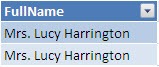
A great thing about the Refresh is that it left our filters intact, you’ll see we are still only looking at Lucy’s, and even better we can see the title of our best customer is now corrected:

clip_image004

If you’re using the same sheet from the previous lessons, you will also notice the calculated column we’d put in place, FullName, is still present.

clip_image005

A word of caution.

When using the Refresh feature, be aware that every time you do a refresh you are pulling the entire dataset back, not just the changed rows. Using SQL Server Profile I monitored the Refresh operation from the server side, and found the query issues was:

SELECT [SalesLT].[Customer].*
  FROM [SalesLT].[Customer]

If you were to attempt this on a large table in your production system during a busy production time it could have severely negative consequences. Imagine the slowdown that would occur if this were executed against a system having hundreds of millions of rows.

When getting into data sets that large, I would advise moving towards a more structured data warehousing environment. This would provide a structure better suited for analysis. If nothing else though, get IT to setup a copy of the production system in a location updated during off peak hours so that analysts could pull massive amounts of data without impacting production systems.

Summary

Taking into account the strain on the source systems, the easy one button refresh does provide a great way for analysts to ensure the data they are making business decisions from is current and up to date.

Lookups in PowerPivot Calculated Columns – Using the RELATED Function

In my previous post we looked at how Calculated Columns work in PowerPivot. One limitation you may have noticed though was all of the calculations were done using values in that individual table. What if you wanted to lookup a value in second table, based on a value in the first table, and return a value from that second table. Yes Virginia, not only is there a Santa Clause but there’s also an answer for us in PowerPivot’s RELATED function.

In addition to the standard Excel functions, PowerPivot provides a set of its own functions for working with its data. These new functions are collectively known as Data Analysis eXpressions, or DAX for short. By now you’ve probably guessed that the first function from the DAX toolbox you’ll want to learn is the RELATED function.

Let’s start with the same Excel 2010 workbook we had at the end of the lesson Combining Data from Multiple Sources in PowerPivot. If you recall we had imported data from the AdventureWorksLT2008 database. To that we added data the CountryInfo table, which we’d typed in to an Excel spreadsheet.

clip_image001

At the time we used this to get the CountryAbbr column, and you may have wondered why we also included a DiscountRate column. It’s this lesson where this DiscountRate will come in to play.

If you recall from that post, we used PowerPivot’s Manage Relationships feature to create a link that ultimately connected the SalesOrderDetail table to the CountryInfo table. This groundwork enables us to lookup values very easily. Here is a simple example. Go to the Add Column column of SalesOrderDetail and enter this formula into the fx area:

=RELATED(‘CountryInfo'[CountryAbbr])

When PowerPivot gets done, the abbreviation for each country to be shipped to appears in this column. This can be used to “flatten out” some of your data. However it’s much more useful when used as part of a calculation. Delete the column we just added (right click on the column header and pick Delete Column from the menu).

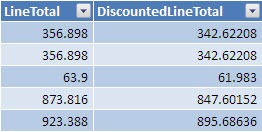
Looking in the CountryInfo table we see the DiscountRate. A value of 0.04 means our US customers get a discount of 4% off their LineTotal. So in our SalesOrderDetail table we want to take the LineTotal and calculate a new value based on the rate, which is stored in the CountryInfo table. Simple enough using the PowerPivot RELATED function.

=[LineTotal] * (1 – RELATED(‘CountryInfo'[DiscountRate]))

This is fairly simple math, we take the DiscountRate from CountryInfo (for US, 0.04) and subtract from 1 giving us 0.96, or 96%. This is then multiplied by the LineTotal giving us our new discounted LineTotal amount, which I renamed to DiscountedLineTotal.

clip_image002

Hopefully these simple examples will give you a glimpse of the immense power RELATED offers. It will allow you to combine data from multiple tables to create in-depth analysis that previously required a specialist in Business Intelligence to create.

Calculated Columns in PowerPivot

When importing data into PowerPivot, users often find the data is almost, but not quite what they need. Perhaps the name is not quite formatted as they need, or some calculation, not important in the stored data but very important to their work, is missing. For these situations PowerPivot offers Calculated Columns.

Calculated Columns provide a way for users to add that missing information they require into the source data. The calculations are done on a row by row basis, if you want to do something on the entire table, for example count the number of rows, you will instead need to create a measure in your PivotTable or PivotChart. Measures will be covered in a later post.

Let’s get started by using the same Excel 2010 workbook we ended with in the previous blog post. If you haven’t seen it, please go back and reference my post Combining Data from Multiple Sources in PowerPivot for the full details.

Our first task will be to address our customer names. In the source data, names are broken into five columns: Title, FirstName, MiddleName, LastName, and Suffix. For ease of use we wish to combine these distinct columns into one single column. Assuming you have opened the PowerPivot workbook, select the Customer table from the list of tabs at the bottom. Now go to the right-most column, ModifiedDate. Next to it you’ll see a blank column with the header “Add Column”. Click in it, then go up to the fx box right above the data.

clip_image001[6]

The formula bar:

clip_image002[6]

Into this formula bar we can create some fairly complex expressions. Let’s do one that shows some of the power of text formulas. Into the formula bar enter:

=[Title] & " " & [FirstName] & " " & IF(LEN([MiddleName]) > 0, [MiddleName] & " ", "") & [LastName] & IF(LEN([Suffix]) > 0, " " & [Suffix], "")

As with Excel, formulas need to begin with the equal sign. All literal string values are enclosed in double quote marks. Here we have two, a single space in the form of “ “ and an empty string in the form of “” (two double quotes right next to each other). The ampersand & character is used for concatenation. When using column names in the formulas, they must be enclosed in square brackets [ ] . Finally notice we’ve leveraged some standard Excel functions, first the LEN function which returns the length of the past in field. Then the IF function which evaluates the first statement (for example, LEN([MiddleName]) > 0 ). Then the area after the first comma ([MiddleName] & " " ) is returned if the statement was true, otherwise the area after the second comma ("" ) is returned.

After pressing enter on our formula PowerPivot will then calculate the values for each individual row in the dataset. The downside is this could take quite a while depending on the size of your data. A 100 million rows of data is going to take a while, even on a fast machine. The benefit though is this is the only time the calculation is done, unless of course the underlying data changes. Values are now calculated and available at analysis time.

You may notice the column name changes from Add Column to CalculatedColumn1. Since this is not something we’d want to show other users, or work with ourselves, simply right click on the column header, pick Rename Column, and give our new column a meaningful name. In this example I used FullName.

clip_image003[6]

A quick side note, in the sample data the MiddleName and Suffix columns are not populated very often, as is often true with real data. However it can make browsing through our data a bit difficult. To validate our calculation, click the drop down menu triangle next to the MiddleName column, go to the bottom and uncheck the “Blank” option for data filtering. This will then remove all rows from the viewed data that are missing a middle name.

Note this doesn’t delete the rows, this is merely a filtering option in PowerPivot to help you view only the data you want. The other rows are still there, to prove it just click the menu arrow again and pick the “Clear filter from MiddleName” menu option and all rows will again be visible. For more information on filtering, see my post Import Filters in PowerPivot. The same filtering tools that apply to the data import process also work once the data is imported.

In addition to textual manipulation, PowerPivot also supports complex math calculations. Let’s do a simple example in the SalesOrderDetail tab. For simplicity, let’s decide that our base profit for any sale is 20 percent of the Line Total. However, for each item ordered we gain an extra 2 percent of profit. We’ll click in the Add Column area of the SalesOrderDetail tab and enter the following calculation:

=(.2 + ([OrderQty] * .02))*[LineTotal]

Now we can rename the column to EstimatedProfit using the rename menu option as described above.

clip_image004[6]

We also have the power of the Excel math functions at our disposal. Let’s do something simple, and decide that we want to round the value of our EstimatedProfit column up to the next whole value. Even if the value was 1.01, it would round up to 2 dollars. To accomplish this we can use Excel’s ROUNDUP function:

=ROUNDUP((.2 + ([OrderQty] * .02))*[LineTotal], 0)

Yields these new results:

clip_image005[6]

As you can see, they have indeed been rounded up to the next whole value. The 0 at the end of the formula indicated how many decimals should remain, I indicated none so we could see the results in whole dollars.

We’ve only just begun to explore the value in Calculated Columns. Not only can they fill in missing data, but they can also speed calculations when you reach the Pivot Table stage of your analysis by making aggregations much easier.

Combining Data from Multiple Data Sources in PowerPivot

Seldom does the user of PowerPivot have all of the data they need in one nice, neat data source. More than often it will be necessary to import data from a variety of sources and make that data work together. It’s time to start building on what we’ve learned over the last few days to accomplish this feat.

First, launch Excel 2010 and use the PowerPivot import wizard to import the following tables from the AdventureWorksLT2008 database: Address, Customer, CustomerAddress, Product, ProductCategory, SalesOrderDetail, SalesOrderHeader. (Note, for a refresher on importing data please see my blog post, Import Filters in PowerPivot.)

Now we need a second source of data. Follow the instructions in my post Creating Tables in PowerPivot to enter the data below into Excel 2010, copy and paste it into a new PowerPivot table.

clip_image001

If you recall when we import data from a relational database, PowerPivot examines the foreign key relationships found in the database to create relationships between the tables it imports. In this situation though, the CountryInfo data didn’t get imported from a database, instead it was pasted in from a manually entered spreadsheet. Thus, PowerPivot has no information with which it can implicitly create a relationship.

We do want to create one however, so we can link the longer country name in the Address table to the CountryInfo data and thus be able to use the briefer country abbreviations. As PowerPivot was designed to work with many sources of data, it has an easy way to create these relationships.

In the PowerPivot window, click on the Table tab at the very top. All the way to the right you will notice a button group named Relationships. Click the Create Relationship button.

clip_image002

As the above dialog shows, this allows you to create a relationship, or a link between two tables in PowerPivot. Here we are creating a link between the Address table and the CountryInfo table on the CountryRegion field. When complete just click Create to create the relationship.

If you want to verify the relationship was indeed created, or review any of the relationships PowerPivot inferred when it imported the tables from the AdventureWorksLT2008 database, just click the Manage Relationships button in the Table Toolbar’s Relationships group.

clip_image003

On the very first row you’ll see the newly created relationship between the Address and CountryInfo tables. You’ll also see the other relationships that were created during the import process from the SQL Server database. The three buttons at the top let us Create new relationships, Edit existing ones, or Delete ones no longer needed. Note that the altering or deleting of relationships has no effect what so ever on the original source data (SQL Server or the Excel 2010 spreadsheet). It only affects the tables as stored in PowerPivot.

Now let’s see the new relationship in action. Close the Manage Relationships window, and on the PowerPivot Home tab create a new PowerPivot table (Pivot Table, Single Pivot Table). Go ahead and put it in a new worksheet.

In the Gemini Task Pane, go to the SalesOrderHeader table and drag the LineTotal field into the Values area. Next, drag the Name field from the Product table into the Row Labels area. Now for the magic, in the CountryInfo table drag the CountryAbbr field into the Column Labels area. Your pivot table should look something like this:

clip_image004

Because of the relationships that were inferred or that we created, PowerPivot was able to link the data like so:

1. SalesOrderDetail linked to SalesOrderHeader on the SalesOrderID column.

2. SalesOrderHeader linked to Address on the ShipToAddressID=AddressID.

3. Address linked to ContryInfo on the CountryRegion column.

To validate this for yourself, just return to PowerPivot and look at the Manage Relationships dialog to see all the links.

The need to combine data from many sources is a common task, one that will most certainly be done by users of PowerPivot. Using the techniques shown here, you can create and manage the relationships that will link data from these disparate sources together and leverage the power of PowerPivot.

Creating Tables in PowerPivot

PowerPivot has the ability to import data from a wide variety of sources. But you could run across a situation where you don’t have that data stored anywhere. Perhaps it’s on a piece of paper, or in a text file, or it’s just in the user’s brain and needs to be typed in. Logically then you would want to create a new table in PowerPivot.

Except you can’t. PowerPivot itself doesn’t provide the ability to create tables and enter data directly into it. Now, before you start the usual rending of garments and gnashing of teeth plus a little wailing, there is a simple to implement solution.

Create a new Excel 2010 workbook. In sheet 1 (or any sheet) let’s enter the following information.

clip_image001

Now highlight the above cells and Copy them to the clipboard. Next, launch the PowerPivot window by going to the PowerPivot tab in Excel 2010 and clicking the PowerPivot window button.

Once PowerPivot is open, if you look in the middle group of buttons you’ll see a set named Paste from Clipboard The To New Table button should be activated now that you have data in your clipboard.

clip_image002

Click the To New Table button. When you do, the Paste Preview dialog appears.

clip_image003

This is similar to the preview window you see with the Import Table wizard, only not quite as much functionality. Here, we can view the data and validate that it is correct, which it is. We can also indicate if the first row contains our column headers, which in our case it does so we can just leave that option checked on. Click OK to import the data.

clip_image004

Above is our new data, now pasted into PowerPivot. We have the same abilities with it we have with any other table, we can sort, rename our columns, add new calculated columns, and more. As you will note from the tab at the bottom of the picture, the data was pasted into a table with the rather uninformative name of Table. We can do better than that, so right click on the Table tab and pick Rename from the menu. Overwrite Table with CountryInfo.

clip_image005

Now you can see how easy it is to create new data from scratch and paste it into PowerPivot. In this example I used a limited number of rows for illustrative purposes, but it’s quite possible to import massive amounts of data. In addition, you can add to your table later. In this example all we would have had to do is Paste Append from the toolbar.

In the next blog post we’ll build on what we’ve learned and look at how to combine data imported from multiple sources.

Import Filters in PowerPivot

PowerPivot has the ability to import millions of rows of data into Excel 2010 for purposes of analyzing, slicing and dicing. However, even though you can import vast amounts of data you may not always want to. There are many reasons for this.

You may wish to limit the amount of data for security reasons. Perhaps bringing in all of the data may put an unneeded strain on the server. Most likely though, is you simply do not need all of the data. As an analyst you may be interested in only the data for a segment of your organization, such as a single plant or department.

Fortunately filtering data is an easy task. If you are not familiar with importing data into PowerPivot, may I suggest you first review my step by step posted yesterday.

Launch Excel 2010 and go to the PowerPivot tab, then launch the PowerPivot window. Select the "From Database" to start the import process, and for this example we’ll use SQL Server. Now, like in my previous blog post enter your credentials to connect to a SQL Server. For this example we’ll just pick one table, SalesOrderDetail from the AdventureWorksLT2008 database.

With the SalesOrderDetail picked, look in the lower right side of the dialog. You will see a button labeled "Preview & Filter".

clip_image001

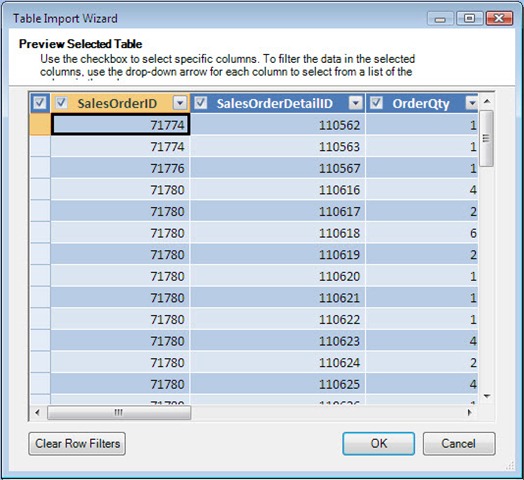
When you click that button you should see a new dialog appear.

clip_image002

Here you can see a subset of your data, only the first few rows. It’s enough to give you an idea of what the data looks like, but it won’t show you every single row. Considering the fact that PowerPivot is capable of importing millions of rows, this is probably a good thing.

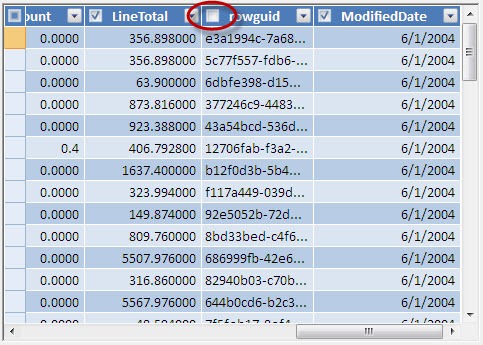
Within this dialog we can do some pretty powerful things. Let’s start by eliminating a column we don’t need in the data we want to import. Scroll to the right until you see the rowguid column and uncheck the box next to the column header, as you see below.

clip_image003

By unchecking this box this column will not be imported into our Excel 2010 PowerPivot table.

Recall though that the name of this dialog was Preview & Filter. We can also do some review of our data to ensure it’s what we want. Let’s say we want to look to see the range of values for our line totals. Click the downward facing triangle button to the right of the LineTotal column header. A drop down menu will appear. Select "Sort Smallest to Largest"

clip_image004

Scrolling through the data you’ll notice that the data has indeed been sorted. Also note the menu icon to the right of the column name changes to indicate a sort has been applied to this column. (Remember though it’s not showing all rows, just the first few sorted in order.) An important thing to note tough, this sorting applies only to the data as you see it in the Preview & Filter area, once you click the Finish button on the Table Import Wizard the sort is removed. While the preview options in this dialog are not saved, filters are. If you had pressed Finished, you’d have seen that rowguid is not included in the result set. But don’t click Finish yet, we’re not quite done filtering.

For our next filter, let’s decide for purposes of this report we are only interested in large orders. We’ll define large as "Line Total greater than 1,000 dollars". Once again open the menu to the right of the LineTotal column header and select "Number Filters". A pop out menu will appear, from it select "Greater Than…"

clip_image005

When the Custom Filter pops up, enter 1000 next to the is greater than box and click OK.

clip_image006

Clicking OK will reveal lesser amounts have been removed. Other filters besides numeric filters are available. For text data, you have "is equal to" and "is not equal to" available. Date filters work the same, having the "is equal to" and "is not equal to" available. I’m hopeful that for date types further functionality will be added in the future, such as date ranges or "is greater/less than" types of functionality.

Let’s click the OK button on the Preview & Filters window to return to the Table Import Wizard. You’ll now see an Applied filters link in the row with the table name, click it to see what filters are in effect.

clip_image007

When you click the link you’ll see:

clip_image008

While you cannot edit this information, it is nice to see it all in one location. Click OK to close and return to the previous window.

Click Finish to complete the import. You will see the data you asked for, only rows with LineTotal greater than 1000 and without the rowguid column.

Hopefully you’ve seen how powerful the filtering tools included with PowerPivot are. Using them you can remove unwanted rows and columns, limiting not only the amount of data you have to pull across the network but that you have to store locally in the PowerPivot Excel 2010 spreadsheet. Limiting your data will ensure only the rows required for the analysis are included, saving time and enhancing security.

SharePoint Saturday Birmingham – Intro to Microsoft PowerPivot

spsbham Last Saturday I not only attended but presented at SharePoint Saturday Birmingham. First I have to give Terry Webster a shout out, he did a fantastic job organizing and running the event. I learned a lot, although I admit I felt a bit like a fish out of water, being a SQL Server guy in the SharePoint pond.

Thanks too to all the volunteers who helped run the show, my co-presenters, and the many vendors who attended. Without the support of all those folks this event would not have been possible.

I also want to thank everyone who attended my PowerPivot presentation. Last Friday I did a rather lengthy overview that encapsulated much of my presentation; here are the slides that you saw at the event.

I also want to give you a quick overview of the steps I did in my demo so you can follow along. First you’ll need the bits. The PowerPivotPro has a good blog entry on where to download them from:

http://powerpivotpro.com/2009/11/18/powerpivot-ctp3-beta-download-links/

All you need are the first two items, Office 2010 Beta 2 and PowerPivot for Excel 2010 to reproduce what I did in the demo I presented.

Next you’ll need some data. I had a SQL Server instance installed and used the AdventureWorks2008 LT database available at CodePlex. The LT version is the light weight version of the full AdventureWorks sample, I chose it for it’s simplicity.

http://msftdbprodsamples.codeplex.com/

If you don’t have SQL Server on your box you can use alternate data, or check with your friendly neighborhood DBA. Many have AdventureWorks installed on a test box and might be able to help you out.

OK, so to get this far you’ve downloaded and installed everything, and have access to a dataset. Ready? Let’s go.

1. Launch Excel 201, and click the PowerPivot tab.

2. Click the PowerPivot window button.

step01

3. Click the “From Database” button on the Home tab. In the menu select “From SQL Server”

step02

4. The Table Import Wizard will appear. In “Server name” field, click the drop down and pick your database server. Leave it set to the “Use Windows Authentication” (unless told otherwise if you are using a database provided by a DBA). Under Database name, pick AdventureWorksLT2008. It’s probably a good idea to click the Test Connection button just to make sure everything is correct. If so press Next to continue.

step03

5. On the next screen, leave it at the default of “Select from a list of tables and views to choose the data to import” and click Next.

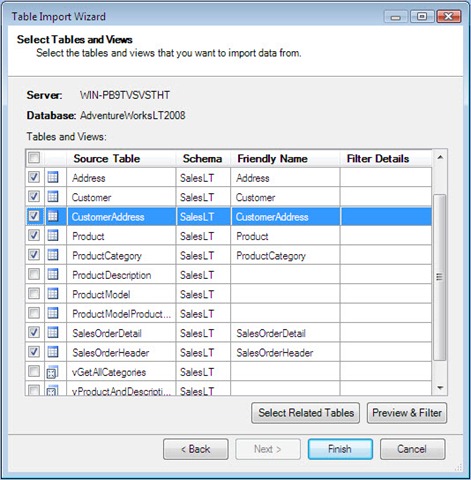
6. On the next screen pick these tables: SalesOrderDetail, SalesOrderHeader, Product, Product Category, Address, Customer, CustomerAddress. Note the “Preview & Filter” button. In the future you may wish to experiment with this to filter the data you are importing, but it’s not needed for this demo. Click Finish to move on.

step04

7. On the next screen you’ll see it importing the tables. When it gives you the Success message click Close.

8. (Note, this next step differs just slightly from the live presentation, in it I added a column but did it in a different place.) Click on the SalesOrderDetail tab. Click on a blank cell under the Add Column out to the right of the data.

9. In this example we’ll decide that 80 percent of our Line Total is cost, which means the other 20% is profit. We’ll calculate the profit by clicking in the fx bar and typing =[LineTotal]*.20

step05

10. Right click on the “CalculatedColumn1” column header and select “Rename column” from the menu. The column header will highlight and allow you to type over it. Change the name to Profit.

11. Click on PivotTable and pick “Single Pivot Table” in the drop down menu.

step06

12. In a pop up dialog, it will ask if you want a new or existing worksheet. Pick “New worksheet” and click OK.

13. Over on the right you will see the “Gemini Task Pane”. Gemini is the original code name for PowerPivot. To create a basic PowerPivot pivot table, follow these steps.

14. Under SalesOrderDetail, click on then drag the LineTotal and Profit fields to the Values area.

15. Under ProductCategory, drag the Name down to Row Labels.

16. Under Product drag the Name to the Row Labels area.

17. Under the Address, click and drag the CountryRegion, then StateProvince to the ColumnLabels area.

18. Drag the StateProvince to the Slicers Vertical area.

19. Your Gemini Task Pane should look something like:

step07

20. Your spreadsheet should look something like:

step08

At this point you have completed all of the steps as shown in the presentation. Now start playing. You can jump back to the PowerPivot data sheets by clicking the “PowerPivot window” button as shown in step 1. Back there you might try experimenting with a chart, or on the pivot table apply different effects and slicers.

Introducing Microsoft PowerPivot

What is PowerPivot? Well according to Microsoft:

“PowerPivot is Microsoft Self-Service Business Intelligence”

I can see from the glazed looks you are giving your monitor that was clear as mud. So let’s step back a bit and first define what exactly is Business Intelligence.

Business Intelligence

Business Intelligence, often referred to as simply “BI”, is all about taking data you already have and making sense of it. Being able to take that information and turn it from a raw jumble of individual facts and transform it into knowledge that you can take informed actions on.

In every organization there is already someone who is doing BI, although they may not realize it. Microsoft (and many IT departments) refer to this person as “that guy”. A power user, who grabs data from anyplace he (or she) can get it, then uses tools like Excel or Access to slice it, dice it, and analyze it. This person might be an actual Business Analyst, but more often it’s someone for who BI is not their main job. Some common examples of people doing their own BI today are production managers, accountants, engineers, or sales managers, all who need information to better do their job. Let’s look at an illustration that will make it a bit clearer.

In this example, put yourself in the role of a sales manager. You have gotten IT to extract all of your sales orders for the last several years into an Excel spreadsheet. In order to determine how well your sales people are doing, you need to measure their performance. You’ve decided that the amount sold will be a good measure, and use Excel to give you totals.

IntroEx01

In BI terms, the column “Total Sales” is known as a measure, or sometimes a fact, as it measures something, in this case the sales amount. The grand total sales amount is often called an aggregation, as it totals up the individual rows of data that IT gave us. But now you might be wondering why Andy’s sales are so low? Well, now you want to dig deeper and look at sales by year.

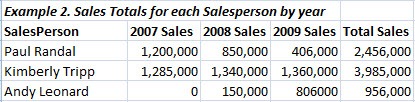
IntroEx02

In BI terms, the names of the sales people are a dimension. Dimensions are often either a “who” (who sold stuff) or a “what” (what stuff did we sell). Places (where was it sold) and dates (when was it sold) are also common dimensions. In this case the sales dates across the top (2007, 2008, 2009) are a date dimension. When we use two or more dimensions to look at our measures, we have a pivot table.

Now we can see a picture emerging. It’s obvious that Andy must have been hired as a new salesperson in late 2008, since he shows no sales for 2007 and very small amount in 2008. But for Paul and Kimberly we can look at something called trends in the BI world. Kimberly shows a nice even trend, rising slowly over the last three years and earns a gold star as our top performer.

By being able to drill down into our data, we spot another trend that was not readily obvious when just looking at the grand totals. Paul has been trending downward so fast the speed of light looks slow. Clearly then we now have information to take action on, commonly known as actionable intelligence.

So remind me, why do we need PowerPivot?

As you can see in the above example, “that guy” in your company clearly has a need to look at this data in order to do his job. Not only does he need to review it, he also has the issue of how to share this information with his co-workers. Unfortunately in the past the tools available to “that guy” have had some drawbacks. The two main tools used by our analyst have been either Excel, or a complete BI solution involving a data warehouse and SQL Server Analysis Services.

Excel’s main limitations center around the volume of data needed to do good analysis. Excel has limits to the number of rows it can store, and for large datasets a spreadsheet can consume equally large amounts of disk space. This makes the spreadsheet difficult to share with coworkers. In addition mathematical functions like aggregations could be slow. On the good side, Excel is readily available to most workers, and a solution can be put together fairly quickly.

A full blown BI solution has some major benefits over the Excel solution. A data warehouse is created, and then SQL Server Analysis Services (often abbreviated as SSAS) is used to precalculate aggregations for every possible way an analyst might wish to look at them. The data is then very easy to share via tools like Excel and SQL Server Reporting Services. While very robust and powerful solution, it does have some drawbacks. It can take quite a bit of time to design, code, and implement both the data warehouse and the analysis services pieces of the solution. In addition it can also be expensive for IT to implement such a system.

Faster than a speeding bullet, more powerful than a locomotive, it’s PowerPivot!

PowerPivot combines the best of both worlds. In fact, it’s not one tool but two: PowerPivot for Microsoft Excel 2010, and PowerPivot for SharePoint 2010. What’s the difference you ask? Good question.

PowerPivot for Microsoft Excel 2010

PowerPivot acts as an Add-on for Excel 2010, and in many ways is quite revolutionary. First, it brings the full power of SQL Server Analysis Services right into Excel. All of the speed and power of SSAS is available right on your desktop. Second, it uses a compression technology that allows vast amounts of data to be saved in a minimal amount of space. Millions of rows of data can now be stored, sorted, and aggregated in a reasonable amount of disk space with great speed.

PowerPivot can draw its data from a wide variety of sources. As you might expect, it can pull from almost any database. Additionally it can draw data from news feeds, SQL Server Reporting Services, other Excel sheets, it can even be typed in manually if need be.

Another issue that often faces the business analyst is the freshness of the data. The information is only as good as the date it was last imported into Excel. Traditionally “that guy” only got extracts of the database as IT had time, since it was often a time consuming process. PowerPivot addresses this through its linked tables feature. PowerPivot will remember where your data came from, and with one simple button click can refresh the spreadsheet with the latest information.

Because PowerPivot sits inside Microsoft Excel, it not only can create basic pivot tables but has all the full featured functionality of Excel at its disposal. It can format pivot tables in a wide array of styles, create pivot charts and graphs, and combine these together into useful dashboards. Additionally PowerPivot has a rich set of mathematical functionally, combining the existing functions already in Excel with an additional set of functions called Data Analysis eXpressions or DAX.

PowerPivot for SharePoint 2010

PowerPivot for Excel 2010 clearly solves several issues around the issue of analysis. It allows users to quickly create spreadsheets, pivot tables, charts, and more in a compact amount of space. If you recall though, creation was only half of “that guys” problem. The other half was sharing his analysis with the rest of his organization. That’s where PowerPivot for SharePoint 2010 comes into play.

Placing a PowerPivot Excel workbook in SharePoint 2010 not only enables traditional file sharing, but also activates several additional features. First, the spreadsheet is hosted right in the web browser. Thus users who might not have made the transition to Excel 2010 can still use the PowerPivot created workbook, slicing and filtering the data to get the information they require.

Data can also be refreshed on an automated, scheduled basis. This ensures the data is always up to date when doing analysis. Dashboards can also be created from the contents of a worksheet and displayed in SharePoint. Finally these PowerPivot created worksheets can be used as data sources for such tools as SQL Server Reporting Services.

Limitations

First, let me preface this by saying as of this writing all of the components are either in CTP (Community Technology Preview, a pre-beta) or Beta state. Thus there could be some changes between now and their final release next year.

To use the PowerPivot for Excel 2010 components, all you have to have is Excel 2010 and the PowerPivot add-in. If you want to share the workbook and get all the rich functionality SharePoint has to offer, you’ll have to have SharePoint 2010, running Excel Services and PowerPivot 2010 Services. You’ll also have to have SQL Server 2008 R2 Analysis Services running on the SharePoint 2010 box. Since you’ll have to have a SQL Server instance installed to support SharePoint this is not a huge limitation, especially since SSAS comes with SQL Server at no extra cost.

One thing I wish to make clear, SharePoint 2010 itself can run using any version of SQL Server from SQL Server 2005 on. It is the PowerPivot service that requires 2008 R2 Analysis Services.

One other important item to note: at some point the load upon the SharePoint 2010 server may grow too large if especially complex analysis is being done. Fortunately SharePoint 2010 ships with several tools that allow administrators to monitor the load and plan accordingly. At the point where the load is too big, it is a clear indication it’s time to transition from a PowerPivot solution to a full BI solution using a data warehouse and SQL Server Analysis Services.

What does PowerPivot mean for business users?

For business users, and especially “that guy”, it means complex analysis tools can be created in a short amount of time. Rich functionality makes it easier to spot trends and produce meaningful charts and graphs. It also means this information can be shared with others in the organization easily, without imposing large burdens on the corporate e-mail system or local file sharing mechanisms.

No longer will users be dependent on IT for their analysis, they will have the power to create everything they need on their own, truly bringing “self service BI” to fruition.

What does PowerPivot mean for Business Intelligence IT Pros?

The first reaction many BI developers have when hearing about PowerPivot is “oh no, this is going to put me out of a job!” Far from it, I firmly believe PowerPivot will create even more work for BI Professionals like myself.

As upper management grows to rely on the information provided by PowerPivot, they will also begin to understand the true value BI can bring to an organization. Selling a new BI solution into an organization where none currently exists can be difficult, as it can be hard to visualize how such a solution would work and the value it brings. PowerPivot allows BI functionality to be brought into an organization at a low development cost, proving the value of BI with minimal investment. Thus when there is a need to implement a larger, traditional BI project those same managers will be more forthcoming with the dollars.

Second, as users pull more and more data, they are going to want that data better organized than they will find in their current transactional business systems. This will in turn spur the need to create many new data warehouses. Likewise the IT department will also want data warehouses created, to reduce the load placed on those same transactional business systems.

I also foresee PowerPivot being used by BI Pros themselves to create solutions. The database structure of many transactional database systems can be difficult to understand even for experienced IT people, much less users. BI Pros can use PowerPivot to add a layer of abstraction between the database and the users, allowing business analysts to do their job without having to learn the complexity of a database system.

BI Pros can also use PowerPivot to implement quick turnaround solutions for customers, bringing more value for the customer’s dollar. When a BI Pro can prove him (or her) self by providing rich functionality in a short time frame it’s almost always the case they are brought back in for multiple engagements.

PowerPivot also provides great value to BI Pros who are employed full time in an enterprise organization. They can create solutions much quicker than before, freeing them up to do other valuable tasks. In addition PowerPivot solutions can provide a “stop gap” solution, pushing the date at which the organization needs to spend the dollars for a full blown BI solution and allowing IT to plan better.

Finally I see great value in PowerPivot as a prototyping tool for larger BI projects. Now users can see their data, interact with it, analyze it, and ensure the required measures and dimensions are present before proceeding with the larger project.

I’ll reiterate, if anything I believe PowerPivot will create an explosion of work for the Business Intelligence Professional.

Where can I learn more?

Well right here for one. I have become quite interested in PowerPivot since seeing it at the SQL PASS 2009 Summit. I think it will be a valuable tool for both myself and my customers. This will be the first of many blog posts to come on PowerPivot. I am also beginning a series of presentations on PowerPivot for local user groups and code camp events. The first will be Saturday, November 21st 2009 at the SharePoint Saturday in Birmingham Alabama, but there will be many more to come. (If you’d like me to come speak at your group just shoot me an e-mail and we’ll see what we can arrange.)

There’s also the PowerPivot site itself:

I’ve also found a small handful of blogs on PowerPivot, listed in no particular order:

Summary

Thanks for sticking with me, I know this was a rather long blog post but PowerPivot has a lot of rich functionality to offer. While PowerPivot is still in the CTP/Beta stage as of this writing, I see more and more interest in the community, which will continue to grow as PowerPivot moves closer to release. I hope this post has set you off on the right step and you’ll continue to come back for more information.

Populating a Kimball Date Dimension

I’m a big fan of the Kimball method of Data Warehousing. A common task most of us setting up a new Data Warehouse face is creating a Date Dimension. In their book, “The Microsoft Data Warehouse Toolkit With SQL Server 2005 and the Microsoft Business Intelligence Toolset”, they have an example of a good date dimension table in their books sample code. My complaint though was not so much with the layout itself, I liked it and found it fairly complete. Instead it was the method they chose to load it. They used an Excel spreadsheet, then a SQL Server Integration Services package to read the Excel file and load the date dimension table.

To me this approach has a couple of drawbacks. First, if you are doing all the loading on the server itself, you may not have Excel loaded. Thus you may be faced with the headache of creating the sheet then figuring out how to get it to a location the server can read. Second, when you go to add more dates in the future, you have to go into the spreadsheet and reset everything, removing what was there before. It can also be quite a headache to go back several years from know and find both SSIS packages and that Excel spreadsheet. Plus after that time changes may be made to both Excel and SSIS that make that solution no longer workable. Finally quite often it’s a DBA setting up the warehouse, and I’ve found there are still a few DBAs who are uncomfortable relying on SSIS, although I’m happy to say that number continues to shrink.

A T-SQL solution was clearly, to me anyway, the superior answer for both ease of use and long term stability. I assumed that as popular as the Kimball method is, someone would have already created a routine to load their style of date dimension, but some Binging and Googling around proved fruitless. I did find some code for loading some very simple date dimensions, but nothing as complete as the Kimball design. So, relishing a good coding challenge, I rolled up my sleeves and went to work. Below is the fruit of my labor, a script for loading a Kimball like date dimension. All you have to do is set the begin and end dates, indicate the offset for your fiscal year, and let ‘er rip. You can easily go back and add more dates by just adjusting the begin and end times.

A few things you should note. First, I did make a few slight modifications to the standard Kimball date dimension table as found in the previously mentioned book. They have a column titled “DateName” which holds the date as a string in YYYY/MM/DD format. As long as I was putting the date in, I decided to add string versions of the date for the US and Europe. These are in MM/DD/YYYY and DD/MM/YYYY formats and the columns are named “DateNameUS” and “DateNameEU” (for European Union) respectively.

Their table also had an audit key, used presumably by the SSIS package. I didn’t really see the need for an audit key for a date table, so I changed it to an identity column so I could have a secondary surrogate key if I needed it, just something to count the number of date rows easily and track the order they were inserted in.

One final, but very important distinction. I was in a post conference session taught by Erik Veerman at SQL PASS 2009. In it he mentioned using Dim and Fact schemas, thus you’d have [Dim].[Date] instead of [dbo].[DimDate]. I liked the idea as it was something I’d been considering myself, so in this version that is what I did. If you use the more traditional naming format of dbo.DimDate you’ll need to tweak the code.

Below is the code to load the Date Dimension table, which is my creation. Under it I placed my modified version of the Kimball Date Dimension table. It’s core code came from the sample code mentioned in the first paragraph then was modified by me. I include it for completeness.

Update: A few readers aptly pointed out I’d missed replacing a static date field when I worked the final version of the code. Made the change to replace the static date with @DateCounter.

Code Sample 1 – Script to load a date dimension.

/*---------------------------------------------------------------------------*/
/* Loads a Date Dimension                                                    */
/*---------------------------------------------------------------------------*/

-- A few notes, this code does nothing to the existing table, no deletes
-- are triggered before hand. Because the DateKey is uniquely indexed,
-- it will simply produce errors if you attempt to insert duplicates.
-- You can however adjust the Begin/End dates and rerun to safely add
-- new dates to the table every year.
--
-- If the begin date is after the end date, no errors occur but nothing
-- happens as the while loop never executes.

SET NOCOUNT ON -- turn off all the 1 row inserted messages

-- Hold our dates
DECLARE @BeginDate DATETIME
DECLARE @EndDate DATETIME

-- Holds a flag so we can determine if the date is the last day of month
DECLARE @LastDayOfMon CHAR(1)

-- Number of months to add to the date to get the current Fiscal date
DECLARE @FiscalYearMonthsOffset INT   

-- These two counters are used in our loop.
DECLARE @DateCounter DATETIME    --Current date in loop
DECLARE @FiscalCounter DATETIME  --Fiscal Year Date in loop

-- Set the date to start populating and end populating
SET @BeginDate = '01/01/2008'
SET @EndDate = '12/31/2010' 

-- Set this to the number of months to add to the current date to get
-- the beginning of the Fiscal year. For example, if the Fiscal year
-- begins July 1, put a 6 there.
-- Negative values are also allowed, thus if your 2010 Fiscal year
-- begins in July of 2009, put a -6.
SET @FiscalYearMonthsOffset = 6

-- Start the counter at the begin date
SET @DateCounter = @BeginDate

WHILE @DateCounter <= @EndDate
      BEGIN
            -- Calculate the current Fiscal date as an offset of
            -- the current date in the loop
            SET @FiscalCounter = DATEADD(m, @FiscalYearMonthsOffset, @DateCounter)

            -- Set value for IsLastDayOfMonth
            IF MONTH(@DateCounter) = MONTH(DATEADD(d, 1, @DateCounter))
               SET @LastDayOfMon = 'N'
            ELSE
               SET @LastDayOfMon = 'Y'  

            -- add a record into the date dimension table for this date
            INSERT  INTO [Dim].[Date]
                    (
                      [DateKey]
                    , [FullDate]
                    , [DateName]
                    , [DateNameUS]
                    , [DateNameEU]
                    , [DayOfWeek]
                    , [DayNameOfWeek]
                    , [DayOfMonth]
                    , [DayOfYear]
                    , [WeekdayWeekend]
                    , [WeekOfYear]
                    , [MonthName]
                    , [MonthOfYear]
                    , [IsLastDayOfMonth]
                    , [CalendarQuarter]
                    , [CalendarYear]
                    , [CalendarYearMonth]
                    , [CalendarYearQtr]
                    , [FiscalMonthOfYear]
                    , [FiscalQuarter]
                    , [FiscalYear]
                    , [FiscalYearMonth]
                    , [FiscalYearQtr]
                    )
            VALUES  (
                      ( YEAR(@DateCounter) * 10000 ) + ( MONTH(@DateCounter)
                                                         * 100 )
                      + DAY(@DateCounter)  --DateKey
                    , @DateCounter -- FullDate
                    , CAST(YEAR(@DateCounter) AS CHAR(4)) + '/'
                      + RIGHT('00' + RTRIM(CAST(DATEPART(mm, @DateCounter) AS CHAR(2))), 2) + '/'
                      + RIGHT('00' + RTRIM(CAST(DATEPART(dd, @DateCounter) AS CHAR(2))), 2) --DateName
                    , RIGHT('00' + RTRIM(CAST(DATEPART(mm, @DateCounter) AS CHAR(2))), 2) + '/'
                      + RIGHT('00' + RTRIM(CAST(DATEPART(dd, @DateCounter) AS CHAR(2))), 2)  + '/'
                      + CAST(YEAR(@DateCounter) AS CHAR(4))--DateName
                    , RIGHT('00' + RTRIM(CAST(DATEPART(dd, @DateCounter) AS CHAR(2))), 2) + '/'
                      + RIGHT('00' + RTRIM(CAST(DATEPART(mm, @DateCounter) AS CHAR(2))), 2)  + '/'
                      + CAST(YEAR(@DateCounter) AS CHAR(4))--DateName
                    , DATEPART(dw, @DateCounter) --DayOfWeek
                    , DATENAME(dw, @DateCounter) --DayNameOfWeek
                    , DATENAME(dd, @DateCounter) --DayOfMonth
                    , DATENAME(dy, @DateCounter) --DayOfYear
                    , CASE DATENAME(dw, @DateCounter)
                        WHEN 'Saturday' THEN 'Weekend'
                        WHEN 'Sunday' THEN 'Weekend'
                        ELSE 'Weekday'
                      END --WeekdayWeekend
                    , DATENAME(ww, @DateCounter) --WeekOfYear
                    , DATENAME(mm, @DateCounter) --MonthName
                    , MONTH(@DateCounter) --MonthOfYear
                    , @LastDayOfMon --IsLastDayOfMonth
                    , DATENAME(qq, @DateCounter) --CalendarQuarter
                    , YEAR(@DateCounter) --CalendarYear
                    , CAST(YEAR(@DateCounter) AS CHAR(4)) + '-'
                      + RIGHT('00' + RTRIM(CAST(DATEPART(mm, @DateCounter) AS CHAR(2))), 2) --CalendarYearMonth
                    , CAST(YEAR(@DateCounter) AS CHAR(4)) + 'Q' + DATENAME(qq, @DateCounter) --CalendarYearQtr
                    , MONTH(@FiscalCounter) --[FiscalMonthOfYear]
                    , DATENAME(qq, @FiscalCounter) --[FiscalQuarter]
                    , YEAR(@FiscalCounter) --[FiscalYear]
                    , CAST(YEAR(@FiscalCounter) AS CHAR(4)) + '-'
                      + RIGHT('00' + RTRIM(CAST(DATEPART(mm, @FiscalCounter) AS CHAR(2))), 2) --[FiscalYearMonth]
                    , CAST(YEAR(@FiscalCounter) AS CHAR(4)) + 'Q' + DATENAME(qq, @FiscalCounter) --[FiscalYearQtr]
                    )

            -- Increment the date counter for next pass thru the loop
            SET @DateCounter = DATEADD(d, 1, @DateCounter)
      END

SET NOCOUNT ON -- turn the annoying messages back on

-- Select all rows inserted for the final year as a sanity check
SELECT  *
FROM    [Dim].[Date]
WHERE DateKey > (YEAR(@EndDate) * 10000)

Code Sample 2 – Modified Kimball code to create a Date dimension.

/* Make sure the Dim schema exists */
IF SCHEMA_ID('Dim') IS NULL
   EXECUTE('CREATE SCHEMA [Dim] AUTHORIZATION [dbo]')
GO

/* Drop table DimDate */
IF EXISTS ( SELECT  *
            FROM    dbo.sysobjects
            WHERE   id = OBJECT_ID(N'[Dim].[Date]')
                    AND OBJECTPROPERTY(id, N'IsUserTable') = 1 )
   DROP TABLE [Dim].[Date]
GO

/* Create table DimDate */
CREATE TABLE [Dim].[Date]
       ( [DateKey] BIGINT NOT NULL
       , [FullDate] DATETIME NULL
       , [DateName] CHAR(11) NULL
       , [DateNameUS] CHAR(11) NULL   --US Date FORMAT, MM/DD/YYYY
       , [DateNameEU] CHAR(11) NULL   --European Union Date Format DD/MM/YYYY
       , [DayOfWeek] TINYINT NULL
       , [DayNameOfWeek] CHAR(10) NULL
       , [DayOfMonth] TINYINT NULL
       , [DayOfYear] SMALLINT NULL
       , [WeekdayWeekend] CHAR(7) NULL
       , [WeekOfYear] TINYINT NULL
       , [MonthName] CHAR(10) NULL
       , [MonthOfYear] TINYINT NULL
       , [IsLastDayOfMonth] CHAR(1) NULL
       , [CalendarQuarter] TINYINT NULL
       , [CalendarYear] SMALLINT NULL
       , [CalendarYearMonth] CHAR(7) NULL
       , [CalendarYearQtr] CHAR(7) NULL
       , [FiscalMonthOfYear] TINYINT NULL
       , [FiscalQuarter] TINYINT NULL
       , [FiscalYear] INT NULL
       , [FiscalYearMonth] CHAR(9) NULL
       , [FiscalYearQtr] CHAR(8) NULL
       , [AuditKey] BIGINT IDENTITY NOT NULL
       , CONSTRAINT [PK_DimDate] PRIMARY KEY CLUSTERED ( [DateKey] )
       )
ON     [PRIMARY]
GO

EXEC sys.sp_addextendedproperty @name = N'Table Type', @value = N'Dimension',
  @level0type = N'SCHEMA', @level0name = N'Dim', @level1type = N'TABLE',
  @level1name = N'Date'
EXEC sys.sp_addextendedproperty @name = N'View Name', @value = N'Date',
  @level0type = N'SCHEMA', @level0name = N'Dim', @level1type = N'TABLE',
  @level1name = N'Date'
EXEC sys.sp_addextendedproperty @name = N'Description',
  @value = N'Date dimension contains one row for every day, beginning at 1/1/2000. There may also be rows for "hasn''t happened yet."',
  @level0type = N'SCHEMA', @level0name = N'Dim', @level1type = N'TABLE',
  @level1name = N'Date'
EXEC sys.sp_addextendedproperty @name = N'Used in schemas',
  @value = N'Sales (3 roles); Finance; Currency Rates; Sales Quota (2 roles; one at Cal Qtr level)',
  @level0type = N'SCHEMA', @level0name = N'Dim', @level1type = N'TABLE',
  @level1name = N'Date'

GO

INSERT  INTO [Dim].[Date]
        ( DateKey
        , FullDate
        , [DateName]
        , [DateNameUS]
        , [DateNameEU]
        , [DayOfWeek]
        , DayNameOfWeek
        , [DayOfMonth]
        , [DayOfYear]
        , WeekdayWeekend
        , WeekOfYear
        , [MonthName]
        , MonthOfYear
        , IsLastDayOfMonth
        , CalendarQuarter
        , CalendarYear
        , CalendarYearMonth
        , CalendarYearQtr
        , FiscalMonthOfYear
        , FiscalQuarter
        , FiscalYear
        , FiscalYearMonth
        , FiscalYearQtr
        )
VALUES  ( -1
        , NULL
        , 'Unknown'
        , 'Unknown'
        , 'Unknown'
        , NULL
        , 'Unknown'
        , NULL
        , NULL
        , 'Unknown'
        , NULL
        , 'Unknown'
        , NULL
        , 'N'
        , NULL
        , NULL
        , 'Unknown'
        , 'Unknown'
        , NULL
        , NULL
        , NULL
        , 'Unknown'
        , 'Unknown'
        )
GO

EXEC sys.sp_addextendedproperty @name = N'Description',
  @value = N'Surrogate primary key', @level0type = N'SCHEMA',
  @level0name = N'Dim', @level1type = N'TABLE', @level1name = N'Date',
  @level2type = N'COLUMN', @level2name = N'DateKey' ;
EXEC sys.sp_addextendedproperty @name = N'Description',
  @value = N'Full date as a SQL date (time=00:00:00)', @level0type = N'SCHEMA',
  @level0name = N'Dim', @level1type = N'TABLE', @level1name = N'Date',
  @level2type = N'COLUMN', @level2name = N'FullDate' ;
EXEC sys.sp_addextendedproperty @name = N'Description',
  @value = N'Standard Date Format of YYYY/MM/DD', @level0type = N'SCHEMA',
  @level0name = N'Dim', @level1type = N'TABLE', @level1name = N'Date',
  @level2type = N'COLUMN', @level2name = N'DateName' ;
EXEC sys.sp_addextendedproperty @name = N'Description',
  @value = N'Standard US Date Format of MM/DD/YYYY', @level0type = N'SCHEMA',
  @level0name = N'Dim', @level1type = N'TABLE', @level1name = N'Date',
  @level2type = N'COLUMN', @level2name = N'DateNameUS' ;
EXEC sys.sp_addextendedproperty @name = N'Description',
  @value = N'Standard European Union Date Format of DD/MM/YYYY', @level0type = N'SCHEMA',
  @level0name = N'Dim', @level1type = N'TABLE', @level1name = N'Date',
  @level2type = N'COLUMN', @level2name = N'DateNameEU' ;
EXEC sys.sp_addextendedproperty @name = N'Description',
  @value = N'Number of the day of week; Sunday = 1', @level0type = N'SCHEMA',
  @level0name = N'Dim', @level1type = N'TABLE', @level1name = N'Date',
  @level2type = N'COLUMN', @level2name = N'DayOfWeek' ;
EXEC sys.sp_addextendedproperty @name = N'Description',
  @value = N'Day name of week', @level0type = N'SCHEMA', @level0name = N'Dim',
  @level1type = N'TABLE', @level1name = N'Date', @level2type = N'COLUMN',
  @level2name = N'DayNameOfWeek' ;
EXEC sys.sp_addextendedproperty @name = N'Description',
  @value = N'Number of the day in the month', @level0type = N'SCHEMA',
  @level0name = N'Dim', @level1type = N'TABLE', @level1name = N'Date',
  @level2type = N'COLUMN', @level2name = N'DayOfMonth' ;
EXEC sys.sp_addextendedproperty @name = N'Description',
  @value = N'Number of the day in the year', @level0type = N'SCHEMA',
  @level0name = N'Dim', @level1type = N'TABLE', @level1name = N'Date',
  @level2type = N'COLUMN', @level2name = N'DayOfYear' ;
EXEC sys.sp_addextendedproperty @name = N'Description',
  @value = N'Is today a weekday or a weekend', @level0type = N'SCHEMA',
  @level0name = N'Dim', @level1type = N'TABLE', @level1name = N'Date',
  @level2type = N'COLUMN', @level2name = N'WeekdayWeekend' ;
EXEC sys.sp_addextendedproperty @name = N'Description',
  @value = N'Week of year', @level0type = N'SCHEMA', @level0name = N'Dim',
  @level1type = N'TABLE', @level1name = N'Date', @level2type = N'COLUMN',
  @level2name = N'WeekOfYear' ;
EXEC sys.sp_addextendedproperty @name = N'Description', @value = N'Month name',
  @level0type = N'SCHEMA', @level0name = N'Dim', @level1type = N'TABLE',
  @level1name = N'Date', @level2type = N'COLUMN', @level2name = N'MonthName' ;
EXEC sys.sp_addextendedproperty @name = N'Description',
  @value = N'Month of year', @level0type = N'SCHEMA', @level0name = N'Dim',
  @level1type = N'TABLE', @level1name = N'Date', @level2type = N'COLUMN',
  @level2name = N'MonthOfYear' ;
EXEC sys.sp_addextendedproperty @name = N'Description',
  @value = N'Is this the last day of the calendar month?',
  @level0type = N'SCHEMA', @level0name = N'Dim', @level1type = N'TABLE',
  @level1name = N'Date', @level2type = N'COLUMN',
  @level2name = N'IsLastDayOfMonth' ;
EXEC sys.sp_addextendedproperty @name = N'Description',
  @value = N'Calendar quarter', @level0type = N'SCHEMA', @level0name = N'Dim',
  @level1type = N'TABLE', @level1name = N'Date', @level2type = N'COLUMN',
  @level2name = N'CalendarQuarter' ;
EXEC sys.sp_addextendedproperty @name = N'Description',
  @value = N'Calendar year', @level0type = N'SCHEMA', @level0name = N'Dim',
  @level1type = N'TABLE', @level1name = N'Date', @level2type = N'COLUMN',
  @level2name = N'CalendarYear' ;
EXEC sys.sp_addextendedproperty @name = N'Description',
  @value = N'Calendar year and month', @level0type = N'SCHEMA',
  @level0name = N'Dim', @level1type = N'TABLE', @level1name = N'Date',
  @level2type = N'COLUMN', @level2name = N'CalendarYearMonth' ;
EXEC sys.sp_addextendedproperty @name = N'Description',
  @value = N'Calendar year and quarter', @level0type = N'SCHEMA',
  @level0name = N'Dim', @level1type = N'TABLE', @level1name = N'Date',
  @level2type = N'COLUMN', @level2name = N'CalendarYearQtr' ;
EXEC sys.sp_addextendedproperty @name = N'Description',
  @value = N'Fiscal month of year (1..12). FY starts in July',
  @level0type = N'SCHEMA', @level0name = N'Dim', @level1type = N'TABLE',
  @level1name = N'Date', @level2type = N'COLUMN',
  @level2name = N'FiscalMonthOfYear' ;
EXEC sys.sp_addextendedproperty @name = N'Description',
  @value = N'Fiscal quarter', @level0type = N'SCHEMA', @level0name = N'Dim',
  @level1type = N'TABLE', @level1name = N'Date', @level2type = N'COLUMN',
  @level2name = N'FiscalQuarter' ;
EXEC sys.sp_addextendedproperty @name = N'Description',
  @value = N'Fiscal year. Fiscal year begins in July.',
  @level0type = N'SCHEMA', @level0name = N'Dim', @level1type = N'TABLE',
  @level1name = N'Date', @level2type = N'COLUMN', @level2name = N'FiscalYear' ;
EXEC sys.sp_addextendedproperty @name = N'Description',
  @value = N'Fiscal year and month', @level0type = N'SCHEMA',
  @level0name = N'Dim', @level1type = N'TABLE', @level1name = N'Date',
  @level2type = N'COLUMN', @level2name = N'FiscalYearMonth' ;
EXEC sys.sp_addextendedproperty @name = N'Description',
  @value = N'Fiscal year and quarter', @level0type = N'SCHEMA',
  @level0name = N'Dim', @level1type = N'TABLE', @level1name = N'Date',
  @level2type = N'COLUMN', @level2name = N'FiscalYearQtr' ;
EXEC sys.sp_addextendedproperty @name = N'Description',
  @value = N'What process loaded this row?', @level0type = N'SCHEMA',
  @level0name = N'Dim', @level1type = N'TABLE', @level1name = N'Date',
  @level2type = N'COLUMN', @level2name = N'AuditKey' ;
EXEC sys.sp_addextendedproperty @name = N'FK To',
  @value = N'DimAudit.AuditKey', @level0type = N'SCHEMA', @level0name = N'Dim',
  @level1type = N'TABLE', @level1name = N'Date', @level2type = N'COLUMN',
  @level2name = N'AuditKey' ;
EXEC sys.sp_addextendedproperty @name = N'Example Values',
  @value = N'20041123', @level0type = N'SCHEMA', @level0name = N'Dim',
  @level1type = N'TABLE', @level1name = N'Date', @level2type = N'COLUMN',
  @level2name = N'DateKey' ;
EXEC sys.sp_addextendedproperty @name = N'Example Values',
  @value = N'11/23/2004', @level0type = N'SCHEMA', @level0name = N'Dim',
  @level1type = N'TABLE', @level1name = N'Date', @level2type = N'COLUMN',
  @level2name = N'FullDate' ;
EXEC sys.sp_addextendedproperty @name = N'Example Values',
  @value = N'23-Nov-2004', @level0type = N'SCHEMA', @level0name = N'Dim',
  @level1type = N'TABLE', @level1name = N'Date', @level2type = N'COLUMN',
  @level2name = N'DateName' ;
EXEC sys.sp_addextendedproperty @name = N'Example Values', @value = N'1..7',
  @level0type = N'SCHEMA', @level0name = N'Dim', @level1type = N'TABLE',
  @level1name = N'Date', @level2type = N'COLUMN', @level2name = N'DayOfWeek' ;
EXEC sys.sp_addextendedproperty @name = N'Example Values', @value = N'Sunday',
  @level0type = N'SCHEMA', @level0name = N'Dim', @level1type = N'TABLE',
  @level1name = N'Date', @level2type = N'COLUMN',
  @level2name = N'DayNameOfWeek' ;
EXEC sys.sp_addextendedproperty @name = N'Example Values', @value = N'1..31',
  @level0type = N'SCHEMA', @level0name = N'Dim', @level1type = N'TABLE',
  @level1name = N'Date', @level2type = N'COLUMN', @level2name = N'DayOfMonth' ;
EXEC sys.sp_addextendedproperty @name = N'Example Values', @value = N'1..365',
  @level0type = N'SCHEMA', @level0name = N'Dim', @level1type = N'TABLE',
  @level1name = N'Date', @level2type = N'COLUMN', @level2name = N'DayOfYear' ;
EXEC sys.sp_addextendedproperty @name = N'Example Values',
  @value = N'Weekday, Weekend', @level0type = N'SCHEMA', @level0name = N'Dim',
  @level1type = N'TABLE', @level1name = N'Date', @level2type = N'COLUMN',
  @level2name = N'WeekdayWeekend' ;
EXEC sys.sp_addextendedproperty @name = N'Example Values',
  @value = N'1..52 or 53', @level0type = N'SCHEMA', @level0name = N'Dim',
  @level1type = N'TABLE', @level1name = N'Date', @level2type = N'COLUMN',
  @level2name = N'WeekOfYear' ;
EXEC sys.sp_addextendedproperty @name = N'Example Values',
  @value = N'November', @level0type = N'SCHEMA', @level0name = N'Dim',
  @level1type = N'TABLE', @level1name = N'Date', @level2type = N'COLUMN',
  @level2name = N'MonthName' ;
EXEC sys.sp_addextendedproperty @name = N'Example Values',
  @value = N'1, 2, …, 12', @level0type = N'SCHEMA', @level0name = N'Dim',
  @level1type = N'TABLE', @level1name = N'Date', @level2type = N'COLUMN',
  @level2name = N'MonthOfYear' ;
EXEC sys.sp_addextendedproperty @name = N'Example Values', @value = N'Y, N',
  @level0type = N'SCHEMA', @level0name = N'Dim', @level1type = N'TABLE',
  @level1name = N'Date', @level2type = N'COLUMN',
  @level2name = N'IsLastDayOfMonth' ;
EXEC sys.sp_addextendedproperty @name = N'Example Values',
  @value = N'1, 2, 3, 4', @level0type = N'SCHEMA', @level0name = N'Dim',
  @level1type = N'TABLE', @level1name = N'Date', @level2type = N'COLUMN',
  @level2name = N'CalendarQuarter' ;
EXEC sys.sp_addextendedproperty @name = N'Example Values', @value = N'2004',
  @level0type = N'SCHEMA', @level0name = N'Dim', @level1type = N'TABLE',
  @level1name = N'Date', @level2type = N'COLUMN',
  @level2name = N'CalendarYear' ;
EXEC sys.sp_addextendedproperty @name = N'Example Values', @value = N'2004-01',
  @level0type = N'SCHEMA', @level0name = N'Dim', @level1type = N'TABLE',
  @level1name = N'Date', @level2type = N'COLUMN',
  @level2name = N'CalendarYearMonth' ;
EXEC sys.sp_addextendedproperty @name = N'Example Values', @value = N'2004Q1',
  @level0type = N'SCHEMA', @level0name = N'Dim', @level1type = N'TABLE',
  @level1name = N'Date', @level2type = N'COLUMN',
  @level2name = N'CalendarYearQtr' ;
EXEC sys.sp_addextendedproperty @name = N'Example Values',
  @value = N'1, 2, …, 12', @level0type = N'SCHEMA', @level0name = N'Dim',
  @level1type = N'TABLE', @level1name = N'Date', @level2type = N'COLUMN',
  @level2name = N'FiscalMonthOfYear' ;
EXEC sys.sp_addextendedproperty @name = N'Example Values',
  @value = N'1, 2, 3, 4', @level0type = N'SCHEMA', @level0name = N'Dim',
  @level1type = N'TABLE', @level1name = N'Date', @level2type = N'COLUMN',
  @level2name = N'FiscalQuarter' ;
EXEC sys.sp_addextendedproperty @name = N'Example Values', @value = N'2004',
  @level0type = N'SCHEMA', @level0name = N'Dim', @level1type = N'TABLE',
  @level1name = N'Date', @level2type = N'COLUMN', @level2name = N'FiscalYear' ;
EXEC sys.sp_addextendedproperty @name = N'Example Values',
  @value = N'FY2004-01', @level0type = N'SCHEMA', @level0name = N'Dim',
  @level1type = N'TABLE', @level1name = N'Date', @level2type = N'COLUMN',
  @level2name = N'FiscalYearMonth' ;
EXEC sys.sp_addextendedproperty @name = N'Example Values',
  @value = N'FY2004Q1', @level0type = N'SCHEMA', @level0name = N'Dim',
  @level1type = N'TABLE', @level1name = N'Date', @level2type = N'COLUMN',
  @level2name = N'FiscalYearQtr' ;
EXEC sys.sp_addextendedproperty @name = N'SCD  Type', @value = N'1',
  @level0type = N'SCHEMA', @level0name = N'Dim', @level1type = N'TABLE',
  @level1name = N'Date', @level2type = N'COLUMN', @level2name = N'DateName' ;
EXEC sys.sp_addextendedproperty @name = N'SCD  Type', @value = N'1',
  @level0type = N'SCHEMA', @level0name = N'Dim', @level1type = N'TABLE',
  @level1name = N'Date', @level2type = N'COLUMN', @level2name = N'DayOfWeek' ;
EXEC sys.sp_addextendedproperty @name = N'SCD  Type', @value = N'1',
  @level0type = N'SCHEMA', @level0name = N'Dim', @level1type = N'TABLE',
  @level1name = N'Date', @level2type = N'COLUMN',
  @level2name = N'DayNameOfWeek' ;
EXEC sys.sp_addextendedproperty @name = N'SCD  Type', @value = N'1',
  @level0type = N'SCHEMA', @level0name = N'Dim', @level1type = N'TABLE',
  @level1name = N'Date', @level2type = N'COLUMN', @level2name = N'DayOfMonth' ;
EXEC sys.sp_addextendedproperty @name = N'SCD  Type', @value = N'1',
  @level0type = N'SCHEMA', @level0name = N'Dim', @level1type = N'TABLE',
  @level1name = N'Date', @level2type = N'COLUMN', @level2name = N'DayOfYear' ;
EXEC sys.sp_addextendedproperty @name = N'SCD  Type', @value = N'1',
  @level0type = N'SCHEMA', @level0name = N'Dim', @level1type = N'TABLE',
  @level1name = N'Date', @level2type = N'COLUMN',
  @level2name = N'WeekdayWeekend' ;
EXEC sys.sp_addextendedproperty @name = N'SCD  Type', @value = N'1',
  @level0type = N'SCHEMA', @level0name = N'Dim', @level1type = N'TABLE',
  @level1name = N'Date', @level2type = N'COLUMN', @level2name = N'WeekOfYear' ;
EXEC sys.sp_addextendedproperty @name = N'SCD  Type', @value = N'1',
  @level0type = N'SCHEMA', @level0name = N'Dim', @level1type = N'TABLE',
  @level1name = N'Date', @level2type = N'COLUMN', @level2name = N'MonthName' ;
EXEC sys.sp_addextendedproperty @name = N'SCD  Type', @value = N'1',
  @level0type = N'SCHEMA', @level0name = N'Dim', @level1type = N'TABLE',
  @level1name = N'Date', @level2type = N'COLUMN', @level2name = N'MonthOfYear' ;
EXEC sys.sp_addextendedproperty @name = N'SCD  Type', @value = N'1',
  @level0type = N'SCHEMA', @level0name = N'Dim', @level1type = N'TABLE',
  @level1name = N'Date', @level2type = N'COLUMN',
  @level2name = N'IsLastDayOfMonth' ;
EXEC sys.sp_addextendedproperty @name = N'SCD  Type', @value = N'1',
  @level0type = N'SCHEMA', @level0name = N'Dim', @level1type = N'TABLE',
  @level1name = N'Date', @level2type = N'COLUMN',
  @level2name = N'CalendarQuarter' ;
EXEC sys.sp_addextendedproperty @name = N'SCD  Type', @value = N'1',
  @level0type = N'SCHEMA', @level0name = N'Dim', @level1type = N'TABLE',
  @level1name = N'Date', @level2type = N'COLUMN',
  @level2name = N'CalendarYear' ;
EXEC sys.sp_addextendedproperty @name = N'SCD  Type', @value = N'1',
  @level0type = N'SCHEMA', @level0name = N'Dim', @level1type = N'TABLE',
  @level1name = N'Date', @level2type = N'COLUMN',
  @level2name = N'CalendarYearMonth' ;
EXEC sys.sp_addextendedproperty @name = N'SCD  Type', @value = N'1',
  @level0type = N'SCHEMA', @level0name = N'Dim', @level1type = N'TABLE',
  @level1name = N'Date', @level2type = N'COLUMN',
  @level2name = N'CalendarYearQtr' ;
EXEC sys.sp_addextendedproperty @name = N'SCD  Type', @value = N'1',
  @level0type = N'SCHEMA', @level0name = N'Dim', @level1type = N'TABLE',
  @level1name = N'Date', @level2type = N'COLUMN',
  @level2name = N'FiscalMonthOfYear' ;
EXEC sys.sp_addextendedproperty @name = N'SCD  Type', @value = N'1',
  @level0type = N'SCHEMA', @level0name = N'Dim', @level1type = N'TABLE',
  @level1name = N'Date', @level2type = N'COLUMN',
  @level2name = N'FiscalQuarter' ;
EXEC sys.sp_addextendedproperty @name = N'SCD  Type', @value = N'1',
  @level0type = N'SCHEMA', @level0name = N'Dim', @level1type = N'TABLE',
  @level1name = N'Date', @level2type = N'COLUMN', @level2name = N'FiscalYear' ;
EXEC sys.sp_addextendedproperty @name = N'SCD  Type', @value = N'1',
  @level0type = N'SCHEMA', @level0name = N'Dim', @level1type = N'TABLE',
  @level1name = N'Date', @level2type = N'COLUMN',
  @level2name = N'FiscalYearMonth' ;
EXEC sys.sp_addextendedproperty @name = N'SCD  Type', @value = N'1',
  @level0type = N'SCHEMA', @level0name = N'Dim', @level1type = N'TABLE',
  @level1name = N'Date', @level2type = N'COLUMN',
  @level2name = N'FiscalYearQtr' ;
EXEC sys.sp_addextendedproperty @name = N'Source System', @value = N'Derived',
  @level0type = N'SCHEMA', @level0name = N'Dim', @level1type = N'TABLE',
  @level1name = N'Date', @level2type = N'COLUMN', @level2name = N'DateKey' ;
EXEC sys.sp_addextendedproperty @name = N'Source System', @value = N'Derived',
  @level0type = N'SCHEMA', @level0name = N'Dim', @level1type = N'TABLE',
  @level1name = N'Date', @level2type = N'COLUMN', @level2name = N'FullDate' ;
EXEC sys.sp_addextendedproperty @name = N'Source System', @value = N'Derived',
  @level0type = N'SCHEMA', @level0name = N'Dim', @level1type = N'TABLE',
  @level1name = N'Date', @level2type = N'COLUMN', @level2name = N'DateName' ;
EXEC sys.sp_addextendedproperty @name = N'Source System', @value = N'Derived',
  @level0type = N'SCHEMA', @level0name = N'Dim', @level1type = N'TABLE',
  @level1name = N'Date', @level2type = N'COLUMN', @level2name = N'DayOfWeek' ;
EXEC sys.sp_addextendedproperty @name = N'Source System', @value = N'Derived',
  @level0type = N'SCHEMA', @level0name = N'Dim', @level1type = N'TABLE',
  @level1name = N'Date', @level2type = N'COLUMN',
  @level2name = N'DayNameOfWeek' ;
EXEC sys.sp_addextendedproperty @name = N'Source System', @value = N'Derived',
  @level0type = N'SCHEMA', @level0name = N'Dim', @level1type = N'TABLE',
  @level1name = N'Date', @level2type = N'COLUMN', @level2name = N'DayOfMonth' ;
EXEC sys.sp_addextendedproperty @name = N'Source System', @value = N'Derived',
  @level0type = N'SCHEMA', @level0name = N'Dim', @level1type = N'TABLE',
  @level1name = N'Date', @level2type = N'COLUMN', @level2name = N'DayOfYear' ;
EXEC sys.sp_addextendedproperty @name = N'Source System', @value = N'Derived',
  @level0type = N'SCHEMA', @level0name = N'Dim', @level1type = N'TABLE',
  @level1name = N'Date', @level2type = N'COLUMN',
  @level2name = N'WeekdayWeekend' ;
EXEC sys.sp_addextendedproperty @name = N'Source System', @value = N'Derived',
  @level0type = N'SCHEMA', @level0name = N'Dim', @level1type = N'TABLE',
  @level1name = N'Date', @level2type = N'COLUMN', @level2name = N'WeekOfYear' ;
EXEC sys.sp_addextendedproperty @name = N'Source System', @value = N'Derived',
  @level0type = N'SCHEMA', @level0name = N'Dim', @level1type = N'TABLE',
  @level1name = N'Date', @level2type = N'COLUMN', @level2name = N'MonthName' ;
EXEC sys.sp_addextendedproperty @name = N'Source System', @value = N'Derived',
  @level0type = N'SCHEMA', @level0name = N'Dim', @level1type = N'TABLE',
  @level1name = N'Date', @level2type = N'COLUMN', @level2name = N'MonthOfYear' ;
EXEC sys.sp_addextendedproperty @name = N'Source System', @value = N'Derived',
  @level0type = N'SCHEMA', @level0name = N'Dim', @level1type = N'TABLE',
  @level1name = N'Date', @level2type = N'COLUMN',
  @level2name = N'IsLastDayOfMonth' ;
EXEC sys.sp_addextendedproperty @name = N'Source System', @value = N'Derived',
  @level0type = N'SCHEMA', @level0name = N'Dim', @level1type = N'TABLE',
  @level1name = N'Date', @level2type = N'COLUMN',
  @level2name = N'CalendarQuarter' ;
EXEC sys.sp_addextendedproperty @name = N'Source System', @value = N'Derived',
  @level0type = N'SCHEMA', @level0name = N'Dim', @level1type = N'TABLE',
  @level1name = N'Date', @level2type = N'COLUMN',
  @level2name = N'CalendarYear' ;
EXEC sys.sp_addextendedproperty @name = N'Source System', @value = N'Derived',
  @level0type = N'SCHEMA', @level0name = N'Dim', @level1type = N'TABLE',
  @level1name = N'Date', @level2type = N'COLUMN',
  @level2name = N'CalendarYearMonth' ;
EXEC sys.sp_addextendedproperty @name = N'Source System', @value = N'Derived',
  @level0type = N'SCHEMA', @level0name = N'Dim', @level1type = N'TABLE',
  @level1name = N'Date', @level2type = N'COLUMN',
  @level2name = N'CalendarYearQtr' ;
EXEC sys.sp_addextendedproperty @name = N'Source System', @value = N'Derived',
  @level0type = N'SCHEMA', @level0name = N'Dim', @level1type = N'TABLE',
  @level1name = N'Date', @level2type = N'COLUMN',
  @level2name = N'FiscalMonthOfYear' ;
EXEC sys.sp_addextendedproperty @name = N'Source System', @value = N'Derived',
  @level0type = N'SCHEMA', @level0name = N'Dim', @level1type = N'TABLE',
  @level1name = N'Date', @level2type = N'COLUMN',
  @level2name = N'FiscalQuarter' ;
EXEC sys.sp_addextendedproperty @name = N'Source System', @value = N'Derived',
  @level0type = N'SCHEMA', @level0name = N'Dim', @level1type = N'TABLE',
  @level1name = N'Date', @level2type = N'COLUMN', @level2name = N'FiscalYear' ;
EXEC sys.sp_addextendedproperty @name = N'Source System', @value = N'Derived',
  @level0type = N'SCHEMA', @level0name = N'Dim', @level1type = N'TABLE',
  @level1name = N'Date', @level2type = N'COLUMN',
  @level2name = N'FiscalYearMonth' ;
EXEC sys.sp_addextendedproperty @name = N'Source System', @value = N'Derived',
  @level0type = N'SCHEMA', @level0name = N'Dim', @level1type = N'TABLE',
  @level1name = N'Date', @level2type = N'COLUMN',
  @level2name = N'FiscalYearQtr' ;
EXEC sys.sp_addextendedproperty @name = N'Source System',
  @value = N'Derived in ETL', @level0type = N'SCHEMA', @level0name = N'Dim',
  @level1type = N'TABLE', @level1name = N'Date', @level2type = N'COLUMN',
  @level2name = N'AuditKey' ;
EXEC sys.sp_addextendedproperty @name = N'Comments',
  @value = N'In the form: yyyymmdd', @level0type = N'SCHEMA',
  @level0name = N'Dim', @level1type = N'TABLE', @level1name = N'Date',
  @level2type = N'COLUMN', @level2name = N'DateKey' ;
GO

TechMixer University – SSIS for Developers

In addition to help recruit speakers, I also had the privilege of speaking at TechMixer University 2009.

The slide deck and main demo can be found at my Code Gallery site:

https://code.msdn.microsoft.com/Release/ProjectReleases.aspx?ProjectName=SSISForDevs&ReleaseId=2883

The calling of SSIS from .Net demo can be found at:

http://code.msdn.microsoft.com/ssisfromnet

Thanks to everyone who attended TechMixer University. I look forward to seeing you next year!

SQL Saturday 25 Gainesville GA – October 10 2009

SQL Saturday 25 Logo

SQL Saturday 25 occurred in the lovely town of Gainesville GA on October 10th. At the event I did two presentations.

My first presentation of the day was Introduction to SQL Server Integration Services. The sample project, slide deck, and step by step instructions can be found at http://code.msdn.microsoft.com/introssis . In addition I also showed how to call SSIS from a .Net application. You can find that sample at http://code.msdn.microsoft.com/ssisfromnet

The second presentation is SQL Server Full Text Searching. You can find the slide deck in PDF format as well as sample code at http://code.msdn.microsoft.com/SqlServerFTS.

Thanks to Stu and the crew for a great event!

Using SSIS Package Configuration Values as Parameters to SQL Tasks

Last weekend I presented at SQL Saturday in Redmond WA. One attendee asked if it was possible to use values from the Package configuration file as parameters to a SQL Task. The answer was a definite yes, although I didn’t have a good example. This post aims to fix that.

Let’s start with the basic workflow. First you will need to create a variable, this variable will be used to pass the value from the config file to the SQL statement. Next you will need to establish a package configuration file, to hold the configured value. After that you will create an Execute SQL Task. In the input statement for the task, simply use ? for each parameter in the T-SQL statement. Finally you’ll click on the Parameter Mapping area of the SQL Task and map the variable to the position of each ?.

Now that you have a basic overview of where we’re going, let’s start this example by creating a simple table to update. Pick your favorite database, or create a test one, then run a simple script to create a table. I used my ArcaneCode database, which I use for samples, and created a table named TestParamToProcs in the dbo schema.

USE [ArcaneCode]
GO

/****** Object:  Table [dbo].[TestParamToProcs]    Script Date: 10/06/2009 21:45:19 ******/
SET ANSI_NULLS ON
GO

SET QUOTED_IDENTIFIER ON
GO

CREATE TABLE [dbo].[TestParamToProcs](
    [ID] [int] IDENTITY(1,1) NOT NULL,
    [SomeText] [nvarchar](50) NULL,
CONSTRAINT [PK_TestParamToProcs] PRIMARY KEY CLUSTERED
(
    [ID] ASC
)WITH (PAD_INDEX  = OFF, STATISTICS_NORECOMPUTE  = OFF, IGNORE_DUP_KEY = OFF, ALLOW_ROW_LOCKS  = ON, ALLOW_PAGE_LOCKS  = ON) ON [PRIMARY]
) ON [PRIMARY]

GO

Now let’s create a new package. I started by opening BIDS (Business Intelligence Developer Studio), creating a solution and named it ConfigFileToSqlParams. I added a Shared Data Source to connect to my database. Next I renamed the default package to ParamToProcs.dtsx. I added the shared data source to the connection managers area of the package.

OK, that takes care of the basics. Next we need to setup the package for variables and a config file. Open up the variables window (click in the Control Surface area, and in the SSIS menu pick Variables.) Create a new variable, we’ll call it MyParam. Make it a string and insert the value of “X” into it.

Now right click on the Control Flow surface (all that yellow area in the Control Flow tab) and pick Package Configurations. Click the check box to “Enable package configurations”, then click the Add button at the bottom of the screen. You are now presented with the Package Configuration Wizard. The first screen is just a welcome screen, you can click past it. The next screen is the “Select Configuration Type” screen. Make sure the default of “XML configuration file” is selected in the drop down. Next under “Specify configuration files directly” enter the path and file name for your config XML file. I named mine ParamToProcsConfig.xml and clicked Next.

The next step in the wizard is the “Select Properties to Export” screen. Expand the Variables area in the tree, then the tree for MyParam, then Properties. Now make sure the only box checked is the one for “Value”.

1_PropsToExport

Click Next once your screen looks like the one above, and you’ll be at the completion screen. Give your package config a good name, I used MyParamConfig, and clicked Finish.

Now let’s drop 3 SQL Tasks into the Control Flow surface. The first task will simply delete all the rows in the table that was just created. That way we can run the package repeatedly. For all three tasks set the Connection to the shared source you added in the Connection Managers area. Now for the SQLStatement of our first task, we’ll use Direct Input and enter this SQL statement:

DELETE FROM dbo.TestParamToProcs

For the next SQL task we’ll insert a row into our table to manipulate. Use this for the SQL Statement property.

INSERT INTO dbo.TestParamToProcs (SomeText) VALUES (‘Hello’)

OK, those were fairly easy and straight forward. Now comes the fun part. For the next SQL Task, we’ll use this statement for the SQLStatement property.

UPDATE dbo.TestParamToProcs SET SomeText = ?

Note the use of the ? (question mark) for the value of the SomeText field. This is the parameter. Now we need to supply a value to this parameter. Over on the left, click the Parameter Mapping tab. Click Add and a new row will be placed in the grid. In the first column, Variable Name, from the drop down pick “User::MyParam”. Leave the Direction as “Input”. Since this is a string variable, we’ll need to change the Data Type column to “VARCHAR”. Finally we need to set the Parameter Name, For this we’ll enter a 0 (zero). We’ll leave the Parameter Size at the default of –1.

2_Params

When your dialog resembles this one, you can click OK. If you needed to use more than one parameter, just use ? for each place where a parameter would go in your T-SQL statement. Then use the values of 0, 1, 2 etc for the Parameter Name. 0 will map to the first ?, 1 to the second, and so on. OK at this point your SSIS package should look something like:

3_Package

If you now run the package, then jump into SQL Server Management Studio and run a “SELECT * FROM dbo.TestParamToProcs”, you should see one row with the SomeText column set to X. Great! Now lets give it one more test. We should change the config file, and run the package outside of BIDS.

First, open notepad or some other text editor, then open up the ParamToProcsConfig.XML file. Move to the <ConfiguredValue> tags, and change the X to something else. I used “ArcaneCode” as it was rather spiffy, but you can use your name, or your cat’s name if you like. Save the file and you can close your text editor.

Now let’s use dtexec to run our package. Open up a command window and navigate to the folder where your package is located. I then used the dtexecui utility to create a package execution command. I’d encourage you to play with this, but so we’re all on the same page here is the dtexec command line I came up with:

dtexec /FILE "D:\Presentations\SQL Server\ConfigFileToSqlParams\ConfigFileToSqlParams\ConfigFileToSqlParams\ParamToProcs.dtsx" /CHECKPOINTING OFF  /REPORTING EW

Of course you’ll want to change the path to wherever you have the ParamToProcs.dtsx package. You should be able to run the above command line and execute your package. If you the jump back to SSMS and rerun the “SELECT * FROM dbo.TestParamToProcs”, you should now see the row with the new value from the config file.

To summarize, the basic steps are:

1. Create the variable

2. Store the variable in a package configuration XML file.

3. Create a SQL Task. Use ? for the parameters in the T-SQL statement.

4. Map the variables to the parameters.

5. Run. Be happy.

And that’s all there is to it.